What is The Middle Path The middle path is empty of desires - swerving to the far right or left, but one founded on balance - ease (when needed) and firmness (when needed). It is acquired by studying the Qura'n, tafsir, sirah, and sitting with scholars and communities who embody its spirit.
How to Achieve Wasatiyyah (Moderation) The first and most important thing is to realize that being guided to Islam is proof that Allah has giving you the start you need to build on moderation. By having faith you are half way there! However, you are responsible for preserving it, causing it to grow and flourish.
So ask the people of the message if you do not know. (16:43)
Striving for the Purification of the Soul
And those who strive for Us - We will surely guide them to Our ways. And indeed, Allah is with the doers of good. (21: 69)
Equality in Punishment( Purity)
O people, those before you gone astray, for if some notable stole, they let him go, and if a poor man did, they penalize him. By Allah, if Fatima, Muhammad's daughter stole, Muhammad most assuredly cut off her hand". Related by al Bokhary
Islam does not allow taking revenge by attacking innocent people. In fact, the concept of revenge itself is un-Islamic, says Maulana Wahiuddin Khan
In just the last couple of days, there have been two deadly attacks orchestrated by self-styled Muslims, killing many people—the attack on a church in Peshawar and a shopping mall in Nairobi. Attacks on, and persecution of, non-Muslim minorities have escalated in recent years in many Muslim-majority countries.
These attacks are nothing but an expression of frustration. The fact is that in the first half of the twentieth century, some Muslims started a struggle against their so-called enemies. But they completely failed in this endeavour. They then tried to destabilise their supposed enemies. What happened on 9/11 was an act of this kind. However, they failed in achieving anything there as well. Now, they have chosen soft targets, like churches and malls. Such acts only show the extent of their frustration. The only cause for these attacks can be found in these Muslims’ deep frustration due to their total failure. The time has now come for Muslims to take a U-turn. Taking a U-turn means accepting one’s own mistakes, but many Muslim leaders do not have the courage to openly accept their mistakes.
Chia seeds are tiny seeds which are packed with essential fatty acids, protein, fiber and many health-protective antioxidants. In fact, weight for weight, these super-seeds provide twice the protein of any other seed or grain, five times the calcium of milk, and an inexpensive, safe and high quality source of omega-3 fatty acids. The Importance of omega-3
Omega-3 is one of the "essential fatty acids" we need in our diets. It is essential because our bodies cannot manufacture it - it has to be obtained from our diet.
Fish is a great dietary source of omega-3, but sea life has been exposed to many toxins. Flax seeds or flax seed oil is a good inexpensive, safe source of omega-3, but chia seeds are more convenient and even higher in omega-3, and are also more easily digestible when whole, than flax seeds.
Cairo was founded by the Fatimidcaliphs as a royal enclosure, and replaced Fustat as the seat of the government. It later came under the Mamluks, ruled by the Ottomans 1517 to 1798, briefly occupied by Napoleon. Muhammad Ali of Egypt made Cairo the capital of his independent empire from 1805 to 1882, after which the British took control of it until Egypt attained independence in 1922.
Today, Greater Cairo encompasses various historic towns and modern districts into one of the most populous cities in the world. It is an amazing city full of life and movement, and it is that way almost 24 hours every day, with the noisy honking of horns, children playing in the streets and merchants selling their wears and services. And here, the Egyptians are most at home in this powerful, modern and ancient city.
Egypt's army has set up two field hospitals on the border with Libya and Libyan guards have withdrawn from their side of the boundary after anti-government protests, the army said on its Facebook page on Monday.
"Members of the Libyan border guard withdrew from (the Libyan side of the border) and it is currently in the control of people's committees," Egypt's Supreme Council of the Armed Forces said in its Facebook message.
Humanitarian Aid convoys have been setting off for Libyan border from the Egyptian capital Cairo as well as other major cities around the country.
The convoys are the result of volunteer work by Egyptians who organized the trip using social networking websites following careful planning.
The organizers also enlisted the help of the Egyptian Doctors Syndicate who chose the type of medical aid that will be most useful for Libyans. Some medical workers are also accompanying the convoy to help the injured in case they come across someone wounded fleeing Libya. They hope to be able to enter Libya and care for the wounded there.
Rome - Forces loyal to Libyan leader Muammar Gaddafi stormed hospitals in Tripoli and summarily executed injured anti-regime protesters who were being treated, a report said on Thursday.
Members of the Libyan Revolutionary Committee, the backbone of Gaddafi's regime, "burst in hospitals and killed wounded people who had protested against the regime," said Slimane Bouchuiguir, who leads the Libyan branch of the International Federation for Human Rights (FIDH), cited by Italian news agency MISNA.
"They transported the corpses to make them disappear, perhaps to burn them, because they know that foreign journalists are moving closer," he said of the incidents that took place Tuesday and Wednesday.
"Doctors who objected were threatened," he added.
The account reached Bouchuiguir in Switzerland, where the rights group is based, because independent organisations are banned in Libya under Gaddafi's 41-year rule.
Into the tenth day of revolts that rights groups claim to have killed at least 600 people, Gaddafi appeared to be losing his grip on Thursday in front of an emboldened opposition and as Western nations mulled sanctions.
الهيئة الدولية للصليب الأحمر مستعدة لإرسال مساعدات طبية إلى ليبيا
In the New York Times, Nicholas Kristof asked 13 questions to test knowledge of his readers on religion ("Test Your Savvy on Religion," October 9, 2010). The questions are:
1. Which holy book stipulates that a girl who does not bleed on her wedding night should be stoned to death?
a. Koran
b. Old Testament
c. (Hindu) Upanishads
2. Which holy text declares: "Let there be no compulsion in religion"?
a. Koran
b. Gospel of Matthew
c. Letter of Paul to the Romans
3. The terrorists who pioneered the suicide vest in modern times, and the use of women in terror attacks, were affiliated with which major religion?
a. Islam
b. Christianity
c. Hinduism Click HERE to read full article.
TIME has named Malalai Joya to the 2010 TIME 100, the magazine’s annual list of the 100 most influential people in the world. Joya has become renown around the world as a courageous advocate of women’s rights and a fierce critic of the NATO war in Afghanistan. The full list and related tributes appear in the May 10 issue of TIME, available on newsstands on Friday, April 30, and now at time.com/tk.
When I first heard this news, I thought it might be an indication that the editors of TIME were open to spreading a dissident's message about the increasingly unpopular war in Afghanistan. Alas, the write-up by Ayaan Hirshi Ali about Joya disabused me of this optimistic notion. Instead of describing Joya's reasons for opposing the NATO occupation of Afghanistan, Hirshi Ali, the author of Infidel who now works for the neoconservative American Enterprise Institute, admonishes Joya: "Malalai, 31, is a leader. I hope in time she comes to see the U.S. and NATO forces in her country as her allies. She must use her notoriety, her demonstrated wit and her resilience to get the troops on her side instead of out of her country. The road to freedom is long and arduous and needs every hand."
Also in the show, Malalai Joya, a young female Afghan MP, who has survived several assassination attempts, talks about why she wants NATO troops to leave Afghanistan.
What is Ayatul Kursi
Praise be to Allaah, we seek His help and His forgiveness. We seek refuge with Allaah from the evil of our own souls and from our bad deeds. Whomsoever Allaah guides will never be led astray, and whomsoever Allaah leaves astray, no one can guide. I bear witness that there is no god but Allaah, and I bear witness that Muhammad is His slave and Messenger.
Bismillah Walhamdulillah Was Salaatu Was Salaam 'ala Rasulillah
As-Salaam Alaikum Wa-Rahmatullahi Wa-Barakatuhu
Perhaps you might have your parents mention Ayatul Kursi, or encourage you to memorise it. It is an ayah (verse) from the Qur'an, in Surah Baqarah. From this ayah we learn some very important facts.
There is no one like Allah. We need Him, but He doesn't need us at all. He is the one who created the Universe. It belongs to Him; He looks after it and protects it. And He never gets tired or sleepy. He knows everything about us and what will happen to us, and any knowledge we have is only what He allows us to have.
Below is a simple meaning of this ayah in English to make it easier for you to understand:
Allahu la ilaha ilia huwal-Hayyul-Qayyum.
Allah. There is no god but He, the Ever-Living, the One who takes care of all that exists.
La ta-khu-zhu-hu sinatun wa la nawm.
Nothing can make Him drowsy or make Him sleep
La hu ma fissamawati wa ma fil-ard
His are all things in the heavens and on earth.
Man dhallladhi yashfa 'ou 'indahu ilia bi idhnihi
Who is there can intercede* in His presence unless He allows it?
Ya'lamu ma bayna aydiyhim wa ma khalfahum
He knows what (appears to His creatures as) before or after or behind them,
Wa la yu hiytoona bi shay-imman 'ilmihi Utah bi ma shaa-a
While they will never have any of HisKnowledge unless He wills.
Wa si'a kursiyuhus-samaawaati wal-ard
His 'Kursi' contains the heavens and the earth,
Wa la ya-ooduhu Hifzuhuma
and He doesn't feel tired in guarding and preserving them
Wahuwal- 'aliyul- 'azeem
for He is the Most High, the Supreme (in glory).
*On the Day of Judgment, there will be no one to 'intercede' in Allah's presence. This means there will be no one to help us, unless He allows them to speak.
Allah's names in this ayat:
Al-Hayy: The One who lives forever and has always lived.
Al-Qayyum: The One who survives by Himself, and looks after all by His Power.
Al-'Aliy : The Most High
Al-'Azeenv : The Supreme, the Great, the Magnificent One.
Some Hadith about
Ayatul Kursi
The greatest verse of the Qur'an:
Abu bhar said; 0 Messenger of Allah, what is the greatest thing that has been revealed to you? He said, "Ayat al-Kursi, 'Allah! La ilaha ilia Huwa...'" [an-Nasa'i]
The benefit of reciting it: He (saws) also said: "When you lie down in your bed, recite ayat al-Kursi, Allah! La ilaha ilia Huwa (none has the right to be worshipped but He), the Ever Living, the One Who sustains and protects all that exists... [al-Baraqah 2:255] until the end of the ayah, then you will have a protector from Allah and no shaytan (devil) will come near you until morning comes." [Sahih al-Bukhari]
What Prophet Muhammad (saws) said about the 'Kursi':
"Compared with the KURSI, the whole universe is as little as a ring thrown upon a desert. Similarly, compared with the 'ARSH (Throne), the kursi is as little as a ring thrown upon the deserf."[Tafsir a-Tabari].
-The 'Arsh is Allah's Throne and Allah is 'above it' (Istawa ala al-Arsh).
http://www.freewebs.com/raziaworld2/whatisayatulkursi.htm
Concerning the virtue of reciting this aayah after the prescribed prayers, it was narrated that Abu Umaamah said: “The Messenger of Allaah (peace and blessings of Allaah be upon him) said: “Whoever recites Aayat al-Kursiy immediately after each prescribed prayer, there will be nothing standing between him and his entering Paradise except death.” This is how it was narrated by al-Nasaa’i in al-Yawm wa’l-Laylah, from al-Hasan ibn Bishr. It was also narrated by Ibn Hibbaan in his Saheeh from Muhammad ibn Humayr, who is al-Homsi, and is also one of the men of al-Bukhaari. The isnaad meets the conditions of al-Bukhaari.
http://www.islam-qa.com/index.php?ref=6092&ln=eng&txt=kursi
Rasool Allah peace be upon him said, "Whoever recites Aayatul Kursi after every Fard (Fard Salat). Only death is keeping him/her from entering Jannah. (As soon as he/she dies, will enter Jannah)
(Nisa'i, Ibne Habban, Ibnelsani A'n Abi Amatah Albahili Radiallah Anhu)
It's in another Hadis that Reciting Ayatul Kursi after one Fard (Fard Salat) will stay in Allah's protection until the next Salat.
(Tibrani Fil Kabeer, A'n Alhasan Bin Ali Radiallah Anhu)
Imam Bihaqi States that the one who recites Ayatul Kursi before falling asleep, Allah Tala gives protection to his/her home and his/her Family.
(Marqat Sharah Mishkaat, Mulla Ali Qaderi, vol. 2 pp. 583)
It's in another Hadees Jinns and Shaitans do not come close to the house in which Ayatul Kursi is recited.
(Tirmizi Altargheeb Wal Tarheeb Lilmanzari vol.2 pp.631)
Hadrat A'isha Radiallah Anha states that a person arrived in the court of Nabi kareem Sallal Laaho Alaihi Wasallam and complained that there is no Barkat (Blessings) in anything in his home. Rasool Allah peace be upon him said, "You do not recite Ayatul Kursi, whichever Food and Curry you will recite Ayatul Kursi on, Allah Tala will give Blessings on that Food and Curry. (Tafseer Dar Manshoor vol. 1 pp. 323)
http://www.islamicacademy.org/html/Dua/Ayatul_Kursi.html
The Benefits of
Ayatul Kursi
It is the Most Respectable Ayat of the Qur'aan Kareem.
1).Hadhrat Ali bin Kaab (Radiahallahu Anhu) remarks that Nabi (Sallallahu alayhi wasallam) asked him," Which is the most high ranking Aayat in the Qur'aan Kareem?" He said, " Allaah and His Rasul know best". Rasulallah repeated this statement very often. Hadhrat Ali (Radiahallahu Anhu) stated, "Ayatul Kursi". Nabi (Sallallahu alayhi wasallam) said:"Oh Abul Munzar (family name of Abi bin Kaab). May you be blessed by this knowledge. I swear by that Being in whose Hands and Control is my life, that this Ayat has one tongue and two lips. It is by the threshold of Allaah's Arsh, Mentioning His purity".
2) Hadhrat Ali (Radiahallahu Anhu) states that there was a room of dates, which he used to guard. He suspected that some dates were going missing. Thus one night he stood vigil and saw an animal like a young person. Hadhrat Ali (Radiahallahu Anhu) said: "I greeted and received a reply". I asked," Who are you? Man or Jinn?" It said, "Jinn. I said, Give me your hand". He outstretched his hand. I noticed that the hand was like that of a dog. Its hair like the hair of the dog. I asked, "Are Jinns created like this?" It said, " the Jinns know there are amongst them more stronger ones". I enquired," Why did you steal?". He replied," I have come to know that you love to give charity so I decided to take a part also." Hadhrat Ali (Radiahallahu Anhu) said: " Who will save us from your evil? It said, Aayatul Kursi which is in Surah Baqarah. He who reads it at night will be saved from our evil till the morning and he who reads it in the morning will be saved from our evil till the night."
In the morning Hadhrat Ali (Radiahallahu Anhu) came to Nabi (Sallallahu alayhi wasallam) and narrated the entire event to him. Nabi (Sallallahu alayhi wasallam) said,"That evil has stated the truth although he is a great liar."
3) It is reported from Hadhrat Askee Baqri that Nabi (Sallallahu alayhi wasallam) came to the abode of the Muhajreen when one person asked, "In the Qur'aan Kareem which is the most lofty Ayat?" Nabi (Sallallahu alayhi wasallam) repeated "Ayatul Kursi".
4) Hadhrat Hassan reports "Marfoonaan"," I have been given Ayatul Kursi. Nabi (Sallallahu alayhi wasallam) said," Surah Fateha, Ayatul Kursi and the two Ayats of Al-Imraan (Shaheedal Allaah - 18th Ayat), and "Qul Allaahumma Malekal mulk til Bi Ghairi Hisaab (Ayat 26/7) are attached to the Arsh and say, "Oh our Rabb, You are sending us onto earth to disobedient ones!!!
Allaah says ," I have given you such status, whosoever from amongst my servants recites you after every Salaat, his resting place will be Jannat. And I will make his abode in Jannatul Quddoos and fulfill 70 needs of his daily needs, the least of which is forgiving him and saving him from all enemies of evils.
It is a quarter of the Qur'aan Kareem.
5) Hadhrat Anas (Radiahallahu Anhu)narrates that Rasulallaah (Sallallahu alayhi wasallam) asked one of his companions: " Oh, so and so are you married?" He replied: "No, I do not have enough wealth that I may marry.", Nabi (Sallallahu alayhi wasallam) said: "Do you know Surah Qul Huwallaahu Ahad?" The Sahaba replied: "I know". Nabi (Sallallahu alayhi wasallam) said: "It is equal to a quarter of the Qur'aan. Nabi (Sallallahu alayhi wasallam) asked: "Do you not know Qul Yaa Ayyuhal Kaafiroon?" The Sababi replied "I know". Nabi (Sallallahu alayhi wasallam) said " "It is equal to a quarter of the Qur'aan." Nabi (Sallallahu alayhi wasallam) asked, "Do you not know Surah "Iza Zul Zilzilaat " ?" The Sahaabi replied, "I Know". Nabi (Sallallahu alayhi wasallam) said: "It is a quarter of the Qur'aan". Nabi (Sallallahu alayhi wasallam) asked: "Do you not know Surah Iza Jaa a Nasrullaahi Wal Fath" The Sahabi replied "I Know" Nabi (Sallallahu alayhi wasallam) said, it is a quarter of the Qur'aan. Nabi (Sallallahu alayhi wasallam) asked: "Do you know the Ayatul Kursi?" The Sahabi replied "I know". Nabi (Sallallahu alayhi wasallam) said, "It is equal to a quarter of the Qur'aan. Marry, Marry, Marry."
Consistency and Ayatul Kursi
6) Hadhrat Anas (Radiahallahu Anhu) said that Nabi (Sallallahu alayhi wasallam) said, "The one who recites Ayatul Kursi after every fard Salaat will be protected until the next Salaat and this is constantly done by a Nabi or a Siddiq or a martyr.
7) Hadhrat Hassan bin Ali (Radiahallahu Anhu) says, "A person once asked: "Oh Rasulallaah (Sallallahu alayhi wasallam) what does that person receive who recites Ayatul Kursi after every Fard Salaat ? Nabi (Sallallahu alayhi wasallam) said: " That person remains under the protection of Allaah until the next Salaat."
8) Hadhrat Anas (Radiahallahu Anhu) says: Rasulallaah (Sallallahu alayhi wasallam) asked; "Do you know which Ayat in the Qur'aan is most lofty? " I said, Allaah and his Rasul know more." Nabi (Sallallahu alayhi wasallam) read Ayatul Kursi
9) Hadhrat Efai bin Abdullah Kallee said that one person asked."Oh Rasulallaah (Sallallahu alayhi wasallam), which Ayat in the Qur'aan is the most lofty one?" Nabi (Sallallahu alayhi wasallam) said: " Ayatul Kursi". The person asked,"Which Ayat has those benefits which you desire for your Ummah, in the Qur'aan?" Nabi (Sallallahu alayhi wasallam) said: "The last Ayat of Surah Baqarah, for it is from the treasures of Allaah from underneath the threshold of the Arsh. It encompasses all the good of this world and the Aakhiraat".
10) Hadhrat Muhammad bin al Saumi bin Al Salsal bin Damasc narrates from his father, who in turn, narrates from his father that Rasulallaah (Sallallahu alayhi wasallam) said: " Whoever recites Ayatul Kursi after every fard Salaat, there is only death between him and Jannat", he will enter into Jannat immediately when he dies.
11) Hadhrat Ibne Anas (Radiahallahu Anhu) says that Rasulallaah (Sallallahu alayhi wasallam) said: "The one who recites Ayatul Kursi after every Fard Salaat, Allaah Ta'aala will grant him a gratifying heart, actions of the truthful and reward like the Ambiyaa .Special mercies will descend upon him, and death is the only barrier from his entrance into Jannat. On dying he will enter Janaat".
Blessing in the food
12) Hadhrat Ayesha (R.A.) narrates that one person came to Nabi (Sallallahu alayhi wasallam) and said that there was absolutely no "Barakat" (blessings) in the things at home. Nabi (Sallallahu alayhi wasallam) replied, "Why are you neglectful of Ayatul Kursi."
Whenever Aayatul Kursi is recited upon food, Allaah Ta'aala will increase the Barakat in that food or curry.
13) Hadhrat Ibn Masood (Radiahallahu Anhu) says that Allaah the Lofty did not create any thing in the skies or on earth, in Jannat or Jahannam, loftier than Ayatul Kursi.
14) Hadhrat Ibn Masood (Radiahallahu Anhu) says that no space in the sky, or on the earth is loftier than Ayatul Kursi.
IF THE POST GIVEN BY ALLAH, HE WOULD MAKE EASY AND HELPS YOU TO FULFILL YOUR RESPONSIBILITY FOR THE UMMAH.
photo credit: talkingplant
I love reading books, and if you’re like me you know the problem is there are too many books and too little time! If you can relate to this, then this post is for you. I overcame this problem by going through several Speed Reading books to develop my reading & comprehension skills.
I’m now able to read a book several times faster, and I’m not exaggerating when I say that I can read a 300 page book in 2 hours. Though most Speed Reading Books focused on Reading Drills, what I found was that by adopting a few basic techniques, one can dramatically & instantly improve their Speed Reading Skills. In this post I’ll be sharing with you these secrets. (A Note: these techniques work best with Non-Fiction books) Step 1: Know the purpose of reading the book
This is the first and perhaps the most important step to enhance your speed in reading. It is to know the purpose you’re reading the book. Is it pleasure reading, self-improvement or looking for details on a particular subject ? Without knowing why you won’t be able to jump into the pool of information to get what you want.
Ask yourself:
First: In an overall scheme of things how worthwhile is the material that I am reading
Second: What do I want or need to remember, as specifically as possible, from this material that I am about to read? Step 2 & 3: Get an Overview of the Book & Author (15 minutes)
* Go through the Front Cover, back cover & inside page cover
* Table of Contents (make a note of chapters that seem interesting)
* Amazon Reviews
* Preface
* Introduction
While going through the Amazon reviews, preface & introduction gather some more information about the author and form an opinion of the Author and why has he written the book.
Doing the above should not take more than 15 minutes. By the end of this step, you should be able to explain to someone in a few sentences what the book is about. If you can do this you’ve completed this step successfully. Step 4: Flip through the entire book (10 minutes)
You’ll be surprised by the wealth of information you’ll come across by just doing this. Flip through every page of the book, spending 0.5 sec to 3 secs a page. You’re not expected to read through the text, but during this exercise, make notice of the following:
* Diagrams
* Sub Headings
* Summary points
* Any exercise
By noticing the above you’ll find your mind automatically absorbing bits of information & connecting the dots between them. Step 5: Getting into the details (1 hour 20 minutes)
Most readers read books by diving right into the details without doing any background work. But by the time you’ve reached this step, you know:
* Why you’re reading the book?
* What the book is about?
* Who the author is?
* How can this book can help you?
Congratulations, you’re well in control of the book and to navigate through it with ease.
From step 2 you would have highlighted the chapters that interest you the most. Be brave start going through these chapters. Don’t feel guilty by jumping to the end of the chapter, usually the end of the chapter will summarize the whole chapter.
You’ll notice more often that not, there are a only few chapters that you need to go through, to know what you need to remember in Step 1. It’s using the 80/20 rule. 80% of the information you require is found in 20% of the book. 20% of the book is approx 50 pages which not take an average reader more than an hour and a half to read. Make sure you underline the Major themes and ideas of each chapter you read. Step 6: Mind Map (15 minutes)
Mind-Mapping is a proven method to effecting summarize lots of information in short use of time and space. You can learn about Mind Mapping from this YouTube Video.
With the information you’ve underlined in Step 5, create a Mindmap to connect the central ideas of the book and each chapter it contains. The center of the MindMap can be the name of the book, and each Chapter you’ve read is a branch from the center. From each Chapter connect the lines How it Works?
Speed reading is not about reading words fast, but it’s more about improving one’s ability to extract the message of the text that is being read. All the techniques above enhance your ability to understand the message of the text, without the need to read through every letter. Benefits of Speed Reading:
* Absorb new ideas faster
* You’ll be able to make time to read a wider range of material
* Greater career success as your ability to acquire and retain knowledge increases dramatically
* Increased confidence to sifting through thick books to get what you want
Try it out! and share your experiences below. http://www.vakil.org/2008/12/24/6-steps-to-read-a-300-page-book-in-2-hours-and-remember-what-youve-read/
Life today (not life as it should be carried on) is an idle cyclical action a movement with no goal! A meaningless pendular action starts with the day only to end at night and night starts only to disappear at dawn. In the mean time, man is busy watching the play of these black and white "mice" who chew the strings of our life until we die. Life (as we live it) is like a theater. Man watches these aimless nights and days. Indeed, what foolish play is conducted! When you are in need, you hope and struggle to overcome your needs. Yet once you achieve this, you view your past efforts humorously. What a senseless philosophy to live by!
Living on a day to day basis, the person lacks direction. His aim is only to live. What exists is a dead spirit in a living body. However, the Hajj experience alters this unhealthy condition!
Once you decide to perform Hajj and take the necessary steps, you are on the road to the actualization of Hajj. Before going to Hajj you reside in your home calm and reposed. Upon entering the state of mind for Hajj, you arise and move away from your routine environment.
Hajj is the antithesis of aimlessness. It is the rebellion against a damned fate guided by evil forces. The fulfillment of Hajj will enable you to escape from the complex network of puzzles. This revolutionary act will reveal to you the clear horizon and free way to migration to eternity toward the Almighty Allah.
Depart from your home. and visit "Allah's house", or the "house of the people"! You, whoever you are, you are a man, Adam's son, and a representative of Allah on earth! You are a relative of Allah, Allah's trustee, His master of nature and a student of God. Allah taught you the names. He made you from His spirit and endowed you with special qualities. You were praised by Him; His angels even prostrated to you. This earth and everything in it was made available to man. God became your "homemate", with you at all times and watching all of your actions. Are you living up to His expectation? Allah is in the hearts of the believers. Prophet Muhammad (PBUH)
Thus Allah knoweth those who are sincere, and knoweth those who are false. Quran 29:3 ... And that Allah may know him who helpeth Him and His messenger, though unseen. ...Quran 57: 25 Lo! We have placed all that is in the earth as an ornament thereof that we may try them: which of them is best in conduct. Quran 18: 7 Who hath created life and death that He may try you, which of you is best in conduct; and he is the Mighty, the Forgiving. Quran 67: 2
With the passage of time and the influence of various forces of the social system which disregard human rights and duties, your character has been changed. The vicissitudes of life have affected you to the degree that you became alienated and neglectful. Originally, with Allah's spirit in your heart, you were supposed to shoulder the responsibility of being Allah's trustee on earth. You were granted time as a means for fulfilling this task but you failed because the gift was used carelessly! By the declining day, Lo! man is in a state of loss. Quran 103: 2-3
ClickHERE to read full article. Source : http://www.islamicity.com/articles/Articles.asp?ref=IC0911-3998
استوووا .... In the program called (ONE FAMILY) on MAJD channel
The speaker was Dr.Yahya Alyahya (head of the CALL to Islam Committee)
He said that Muslims are never disorganized; they just need to be CONVINCED.
THEN HE TOLD A STORY OF AN AMERICAN NON MUSLIM MAN WHO WAS DISCUSSING ABOUT ISLAM WITH HIM WHILE HE WAS WATCHING LIVE .ON BROADCAST OF SALAT ISHA FROM KAABAH, ON TV
The American man was so amazed of how crowded is the masjid, more than 3 million Muslims were there at the last nights of the holy month of Ramadan, so crowded, so disorganized
The sheikh asked the Non-Muslim man: How long do you think they'll take to organize themselves in rows and start the Salaat?
He answered: at least 2-3 hours
The sheikh said: but the masjid (HARAM) of Kaaba is 4 floors
The man said: OH, this's will make it about 12 hours then
The sheikh said: put in your mind that they are from countries all over the world with different languages.
The American man said: THEN IT's IMPOSSIBLE TO ORGANIZE THEM BY ANY MEANS!!
Then the Salaat time came, and sheikh Sudais of Makkah stood up and said (ESTAWOO)=Arrange yourselves
And within seconds, the whole scene changed and the crowd of 3 million Muslims arranged themselves in well-organized rows in NO TIME
The American man stared at the TV screen for a moment, and then said: ASH-HADU AN LA ILAHA ILLA ALLAH WA ANNA MOHAMMADAN RASOOLOLLAH. (I bear witness that there is none worthy of worship but ALLAH, and I bear witness that Mohammad is His Servant and Messenger)
As far as I know, doctors and medical personnel are concerned with maintaining health and preventing disease. This is their job and this is their mission. No excuse to do any other actions through this job. They are not allowed to use job for doing the reverse of its mission. So, how doctors do these activities?
·Infecting persons and prisoners intestinally with STD in Guatemala!
·Not treating black American patients with Syphilis for years and giving them placebo without telling them in USA!
·Performing mental and surgical procedures against soliders and prisoners during world war in Europe!
·Testing some unsafe medicines and vaccines in Africa!
·Doing intentionally spinal cord injury for healthy one to be paralyzed in KSA!
The response of USA authorities is highly appreciated. However (sorry) is not enough. The issue is code of ethics among medical personnel and authorities. How these activities were done? In the dark or in the eye and acceptance of the authorities? How these medical teams accepted to share in these projects? We need to perform medical practices that match our mission not against it. We need to endorse the code of ethics again deeply among medical personnel.
By Soroor Ahmed, TwoCircles.net,
Though the September 30 Allahabad High Court verdict is too legal to be analysed in simple terms its one important fall-out is that it provided an opportunity to make the young generation aware of what actually happened in the tumultuous 5-6 years of the Ram Janambhoomi movement.
Even in this age of information explosion a large number of Hindu and Muslim youths under the age of 20 were, till a month back, totally unaware of what actually happened on, before and after December 6, 1992 -- the day the structure was brought down by a mob of thousands led by BJP leaders Lal Krishna Advani, Murli Manohar Joshi and Uma Bharati. That was not enough. The rampaging mob then went on killing and maiming Muslims and destroying their property. At places innocent passengers were thrown from the running trains or killed on roads while on way to home.
L.K. Advani ON the Somnath-Ayodhya rath yatra of 1991 [Photo: The Hindu]
The court judgement of September 30 does not in any way exonerate the killing of thousands of innocent men, women and children on the run-up to the movement to demolish the structure. Even several Hindus were killed in police firing when earlier attempt was made on Babri Masjid during the chief ministership of Mulayam Singh Yadav.
What happened from Bhagalpur in October 1989 to Surat in December 1992 (where Muslim women were stripped naked and paraded during the riots) to Mumbai in December1992-January 1993 was virtually blacked out by a large section of the media in the later years. The Lucknow Special Court ruling prompted the media to recall some of those facts before the people.
Till a few weeks back the upcoming generation was aware of what happened on March 12, 1993 in Mumbai, where serial blasts killed around 250 innocent people. But they were hardly aware of what actually happened in months and years preceding that incident. Now they have become aware of both the heinous crimes against humanity––not just one.
The verdict, in no way, justified the demolition when the case relating to it was sub-judice and when one of the party was ready to accept the court judgement from the very beginning.
Though Muslims were mostly the victims of the prolong movement, the tragedy is that the older generation of the community failed to pass on to the Gneration-Next what actually transpired, who conspired, who whipped up mass hysteria and provocked the general people and who played the heroic role in safeguarding the secular character of the country.
Uma Bharti in jubilant mood after the demolition of Babri Masjid on 6th December 1992 [Photo: OutlookIndia]
For example, even the harshest critic among Muslims of Mulayam Singh Yadav and Lalu Yadav are now forced to recall their contributions to the cause of secularism when they were the chief ministers of the respective states. They were the two men who, then stood the test of the time. And that too when most of the so-called secular elements in the Congress were hand-in-glove with the communalists. The Left too did not play much important role in resisting the movement as one expected them to do. This in spite of the fact that the local MP of Faizabad between November 1989 and May-June 1991 was Mitrasen Yadav of the Communist Party of India. Ayodhya falls under Faizabad parliamentary constituency. It was in 1991 election that Vinay Katiyar of the Bajrang Dal won on the BJP ticket. Mitrasen later joined the Samajwadi Party.
The only exception among the Left is the CPI ML (Liberation), whose cadres came out strongly in their fight against the saffron brigade in a few places in North India.
As the verdict provided an opportunity to debate and discuss in media the whole chain of events it also gave an idea to the coming generation about the gravity of the situation. The fear, panic and uncertainity which gripped the country in the last few days before the September 30 judgement reminded the older generation of those heydays of the movement when the whole country was brought to a standstill. Parents, especially Muslims, were not sending their sons and daughters to schools and colleges, people would avoid journey and remain confined to home after sunset in many parts of the country.
Journey of terror: death and destruction following Advani's rath yatra in 1990. [The Hindu]
We are now in the position to look at the history from hindsight and can react more maturely. It is good that even the Sangh Parivar leaders, from the RSS chief Mohan Bhagwat to Lal Krishna Advani and Narendra Modi, are trying to say that it is not the issue of defeat and victory. But the next generation has now become aware as to how these people celebrated on the streets of Ayodhya and many parts of the country the demolition of Babri Masjid. Media have now highlighted the photos which show Advani, Joshi, Uma Bharati and others hugging each other as the 464 years old structure was being brought down. The slogan Ek Dhako Aur Do (Give one more shove) to pull down the mosque is now known to the new generation.
Had the parties been more sensible and mature the solution could have been reached without shedding blood. The whole movement certainly polarized the country no end and gave birth to hotheads among the Muslims too. More than the verdict, the unwinding of the whole chain of events––obviously the by-product of the judgement––may go a long way to change the thinking of both the communities.
Unlike till early 1990s the passion has subsided and people have become more rational. Time has proved a great healer. Even the Sangh Parivar knows that they cannot whip up the same fervour and sentiment on the same issue once again in less than two decades. This is a lesson for the future generation.
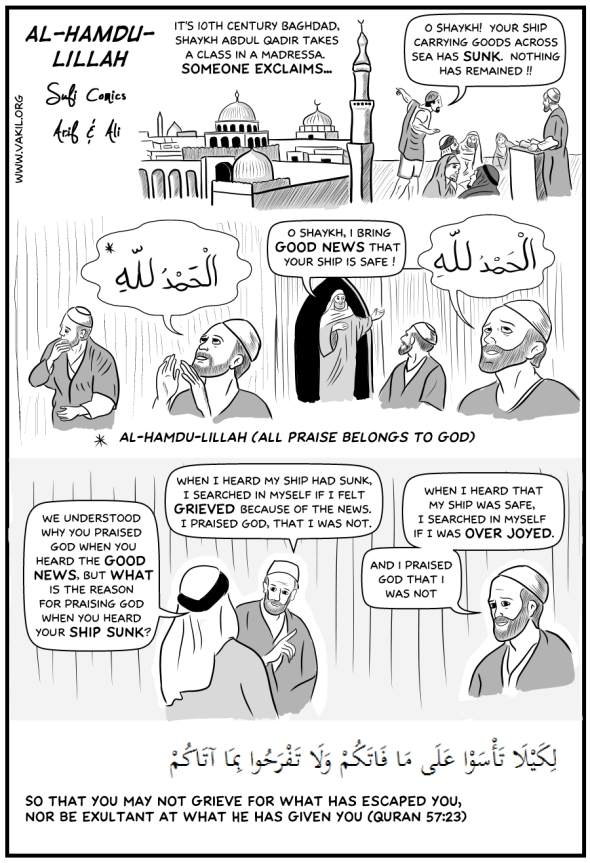
I heard this story from my friend Ishaq Qadri, who happens to be from the descendants of Shaykh Abdul Qadir. A wonderful principle to bring into our lives. To praise God in all situations, and have trust in Him that it all happens for the best.
By Zohaib Bin Akbar,
The recent global financial crisis has opened a debate over the loopholes in conventional banking system. Many scholars and finance experts are of the view that Islamic banking is an alternative to the conventional banking system, which is foolproof enough to restrict any other financial crisis in the future.
Although the Islamic banking industry has been operating from the past 30 years in the Middle Eastern countries, yet it has gained popularity and curiosity around the globe after the financial crisis of 2008. The main objective of Islamic finance is to create a society of investors, unlike the conventional banking system, which has made and created the society of borrowers and lenders from the past 800 years.
Islamic banking activities are to promote public interest, prevent malpractices, contribute towards the development of socio-economic justice and create investment society not a debt-ridden society. They focus on the real sector of the economy.
All financing under Islamic banking is asset backed, i.e. every financial activity should have an under lying asset. There is a concept of IWADH in Islam, which is one of the pillars of Islamic banking. It states that every economic activity undertaken should involve certain amount of ‘risk’, there should be ‘hard work’ or ‘effort’ put in it and there should be a ‘liability’ involved.
The three main things, which are not allowed under the purview of Islamic banking, are Al-riba (interest or usuary), gharar (extreme uncertainty), mysir (gambling). Anything in excess for which no effort or hardship has been put in is considered as riba. Thus, Interest is one form of riba and therefore, it is not allowed in Islam. Gharar refers to the extreme uncertainty or it may be referred as what we have today is speculation. Mysir refers to the game of chance. For example, gambling or betting, which is not allowed as it leads to a zero some game. In gambling the future outcome of an event is predicted without proper collection of facts, analysis and interpretation.
Every product that Islamic bank offers is based on contracts like Mudaraba (partnership), Musharaka (joint venture), Murabaha (cost-plus), Ijara (leasing), and some hybrids combining two contracts (Musharaka Mutanaqisa) etc. Islamic bank involves itself in real time trading or investment activities by doing partnership with its customer through the above-mentioned contract of Mudaraba, or may be by the contract of joint venture (Musharaka) and therefore earns profit. The other sources of revenue for the bank are the service charge that they earn for providing facilities of letter of guarantee or letter of credit to its customers, either corporate or individual.
Today, Islamic banks around the world have a bigger non-Muslim customer base than Muslim counterparts. Many conventional banks like HSBC, Citi, Standard Chartered, RBS, etc have started Islamic banking windows.
It regards the public interest above all other motives or objective. Moreover, the creditor and debtor relationship in the conventional banking system have widened the gap between the rich and the poor (i.e., the rich are getting richer and vice-versa), and have become a real cause of many financial crises over the years and around the world.
Many countries around the world have already made necessary regulatory changes to pave way for Islamic banking, Today, Islamic banking is not only in the Muslim world but also in many non-Muslim countries. Malaysia is the hub for Islamic finance in Asia and it is competing very closely with UK to become the hub for Islamic finance in the world. Even countries like France have recently made necessary changes in order to attract Islamic finance investments. Soon Indonesia, which has the largest Muslim population in the world, is going to kick start the Islamic banking in the country.
India, which has the second largest Muslim population in the world, with a sound and strong economic fundamentals and being the second fastest growing economy, should also fasten up the desired regulatory changes and work towards the implementation of Islamic banking in the country.
(The author is MBA in Islamic Banking & Finance from International Islamic University Malaysia (IIUM). He can be contacted at Zohaib_bin@yahoo.com.) Source : http://www.twocircles.net/?q=2010sep21/banking_islamic_finance.html