By Abdul Hannan Siwani Nadvi for TwoCircles.net
As the age of research work, quality education and divine power that had been empowering Muslims to face the challenges of every era moved out from them all over the world, another tendency has grown very rapidly among Muslims. It is the tendency to push the blame on the Ulema, holding them accountable for every failure, pointing fingers towards some specific Islamic laws, declaring the syllabus being taught in Madrasas and religious institutions as outdated and terming Madrasas as a symbol of old age – which is seen especially in the Muslim community in India.
The Sachar Commission report makes the air clear about Madrasas - the percentage of Muslims who approach Madrasas for education is only 4, even the financial condition of Madrasas, teachers and students who study there is not much better. As it is known to all Muslims, Madrasas, except for some, have no good infrastructure due to very bad financial conditions as they are run solely by donations from Muslims. In such an atmosphere, is it just to expect the 4% to solve all the problems of Muslims, the problems being plenty?
Laziness, dullness, distancing themselves from hard work, selecting short-cut ways to make money, wasting time in watching films and TV programs, or taking part in unnecessary works and making themselves busy in nonsense subjects, or trying to get awards and fame by making comments against the Ulema – indeed all these paved the way for majority of Muslims to put the Ulema on target so that the latter can cover their failure and no one would blame them for the deteriorating situation of Muslims in India.
Pushing the blame on Ulema and pointing the finger towards Madrasas is a very easy task, but conceding our own faults and mistakes is very hard work for most of us. Do we forget what our behavior with the Ulema and Madrasas are? How do the Madrasa people get donations and how do they collect it from every Muslim so that they can arrange a free education to poor Muslims in Madrasas?
Is collecting donations an easy work? When the representatives of Madrasas knock the doors of Muslim homes and ask some donation for Madrasas, during the month of Ramzan or in normal days, what do most of us do? Why do we misbehave with them? Why do we treat them as if they were beggars? Even my own personal experience is very harsh; very few people treat them with respect and dignity, most of us close the door before them, some of us make excuses. Some of us ask them to come after two hours and when the representatives come after two hours, they are said there is nobody in the home and asked to come the next day. When these representatives come again, we do not open the door, or they are told from the window to go away and never to come. Some of us tell them we are against Madrasas, hence we will not give any donation. And if some agree to pay the donation, they give just 10 rupees or 5 rupees or 20 or 30 rupees. And these representatives of Madrasas, despite this misbehavior, go from door to door, room to room, house to house, knock every door to collect 5 or 10 or 20 or 50 rupees. Some of us drive them off, some of us use abusive language against them, some advise them to leave the Madrasas, some of us say to them “you cheat the people” but no one asks them, ‘please come in my home, have a tea, have some cold water’, or ‘please have lunch with us today or tomorrow’. Most of us throw hundreds of questions on them for giving just 10 or 20 rupees, such as ‘where are you from?’ ‘Who are you?’ ‘Give details of the madrasa,’ etc. And at last, unwillingly, grudgingly and resentfully we agree to give a mere 10 or 20 rupees; while thousands rupees are being spent in purchasing an item just because our children like it.
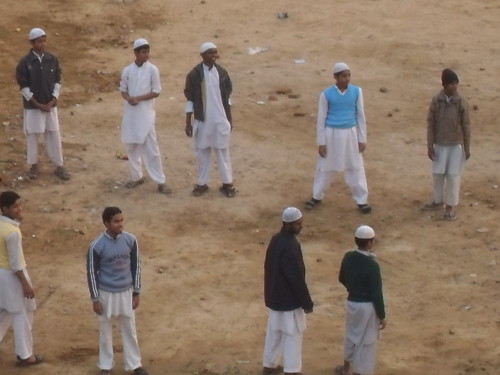
Students of a Delhi madrasa.
As the age of research work, quality education and divine power that had been empowering Muslims to face the challenges of every era moved out from them all over the world, another tendency has grown very rapidly among Muslims. It is the tendency to push the blame on the Ulema, holding them accountable for every failure, pointing fingers towards some specific Islamic laws, declaring the syllabus being taught in Madrasas and religious institutions as outdated and terming Madrasas as a symbol of old age – which is seen especially in the Muslim community in India.
The Sachar Commission report makes the air clear about Madrasas - the percentage of Muslims who approach Madrasas for education is only 4, even the financial condition of Madrasas, teachers and students who study there is not much better. As it is known to all Muslims, Madrasas, except for some, have no good infrastructure due to very bad financial conditions as they are run solely by donations from Muslims. In such an atmosphere, is it just to expect the 4% to solve all the problems of Muslims, the problems being plenty?
Laziness, dullness, distancing themselves from hard work, selecting short-cut ways to make money, wasting time in watching films and TV programs, or taking part in unnecessary works and making themselves busy in nonsense subjects, or trying to get awards and fame by making comments against the Ulema – indeed all these paved the way for majority of Muslims to put the Ulema on target so that the latter can cover their failure and no one would blame them for the deteriorating situation of Muslims in India.
Pushing the blame on Ulema and pointing the finger towards Madrasas is a very easy task, but conceding our own faults and mistakes is very hard work for most of us. Do we forget what our behavior with the Ulema and Madrasas are? How do the Madrasa people get donations and how do they collect it from every Muslim so that they can arrange a free education to poor Muslims in Madrasas?
Is collecting donations an easy work? When the representatives of Madrasas knock the doors of Muslim homes and ask some donation for Madrasas, during the month of Ramzan or in normal days, what do most of us do? Why do we misbehave with them? Why do we treat them as if they were beggars? Even my own personal experience is very harsh; very few people treat them with respect and dignity, most of us close the door before them, some of us make excuses. Some of us ask them to come after two hours and when the representatives come after two hours, they are said there is nobody in the home and asked to come the next day. When these representatives come again, we do not open the door, or they are told from the window to go away and never to come. Some of us tell them we are against Madrasas, hence we will not give any donation. And if some agree to pay the donation, they give just 10 rupees or 5 rupees or 20 or 30 rupees. And these representatives of Madrasas, despite this misbehavior, go from door to door, room to room, house to house, knock every door to collect 5 or 10 or 20 or 50 rupees. Some of us drive them off, some of us use abusive language against them, some advise them to leave the Madrasas, some of us say to them “you cheat the people” but no one asks them, ‘please come in my home, have a tea, have some cold water’, or ‘please have lunch with us today or tomorrow’. Most of us throw hundreds of questions on them for giving just 10 or 20 rupees, such as ‘where are you from?’ ‘Who are you?’ ‘Give details of the madrasa,’ etc. And at last, unwillingly, grudgingly and resentfully we agree to give a mere 10 or 20 rupees; while thousands rupees are being spent in purchasing an item just because our children like it.
Students of a Delhi madrasa.


