Showing posts with label Islam Ramadan. Show all posts

Wednesday, September 8, 2010

Eid Wishes

Assalamu Alaikkum and Eid Mubarak.

In the name of Allah The most Gracious The most Merciful!
Indeed all the praises are due to Allah, we praise him and we seek his assistance and forgiveness, and we seek refuge in Allah.
May this Eid Day is full of blessings for you, your family and friends.
To all of my readers and friends, Eid Mubarak across the miles. May Allah accept all your good deeds and bless you and your families abundantly!                
                                                 S.E.A.Mohamed Ali Jinnah, (“nidurali”)

View more presentations from Xenia Yasmin

Saturday, August 28, 2010

Surat Al-Baqarah (The Cow) - سورة البقرة


Surat Al-Baqarah (The Cow) - سورة البقرة

Enlarge Text
Shrink Text
This is a portion of the entire surah. View more context, or the entire surah.

2:182
Transliteration
Faman khafa min moosinjanafan aw ithman faaslaha baynahum falaithma AAalayhi inna Allaha ghafoorun raheem
Sahih International
But if one fears from the bequeather [some] error or sin and corrects that which is between them, there is no sin upon him. Indeed, Allah is Forgiving and Merciful.
Yusuf Ali
But if anyone fears partiality or wrong-doing on the part of the testator, and makes peace between (The parties concerned), there is no wrong in him: For Allah is Oft-forgiving, Most Merciful.
French
Mais quiconque craint d'un testateur quelque partialité (volontaire ou involontaire), et les réconcilie, alors pas de péché sur lui car Allah est certes Pardonneur et Miséricordieux !
Malay
Tetapi sesiapa yang mengetahui bahawa orang yang berwasiat itu tidak adil atau melakukan dosa (dalam wasiatnya), lalu ia mendamaikan antara mereka (waris-waris, dengan membetulkan wasiat itu menurut aturan ugama), maka tidaklah ia berdosa. Sesungguhnya Allah Maha Pengampun, lagi Maha Mengasihani.
Thai
แล้ว ผู้ใดเกรงว่า ผู้ทำพินัยกรรมมีความไม่เป็นธรรม (โดยไม่รู้) หรือกระทำความผิด(โดยเจตนา) แล้ว แล้วเขาได้ประนีประนอมในระหว่างพวกเขา ก็ไม่มีโทษใด ๆ แก่เขา แท้จริงอัลลอฮ์เป็นผู้ทรงอภัยผู้ทรงเมตตาเสมอ
Turkish
Her kim de vasiyet edenin, bir hata islemesinden veya bir günaha girmesinden endise eder de taraflarin arasini düzeltirse, ona bir vebal yoktur. Süphesiz ki, Allah çok bagislayicidir, çok merhamet edicidir.
Tamil NEW
ஆனால் வஸிய்யத்து செய்பவரிடம்(பாரபட்சம் போன்ற) தவறோ அல்லது மன முரண்டான அநீதமோ இருப்பதையஞ்சி ஒருவர் (சம்பந்தப்பட்டவர்களிடையே) சமாதானம் செய்து (அந்த வஸிய்யத்தை)சீர் செய்தால் அ(ப்படிச் செய்ப)வர் மீது குற்றமில்லை. நிச்சயமாக அல்லாஹ் மன்னிப்பவனாகவும்; நிகரற்ற அன்புடையோனுமாகவும் இருக்கிறான்.

2:183
Transliteration
Ya ayyuha allatheena amanookutiba AAalaykumu assiyamu kamakutiba AAala allatheena min qablikum laAAallakumtattaqoon
Sahih International
O you who have believed, decreed upon you is fasting as it was decreed upon those before you that you may become righteous -
Yusuf Ali
O ye who believe! Fasting is prescribed to you as it was prescribed to those before you, that ye may (learn) self-restraint,-
French
ô les croyants ! On vous a prescrit as-Siyam comme on l'a prescrit à ceux d'avant vous, ainsi atteindrez-vous la piété,
Malay
Wahai orang-orang yang beriman! Kamu diwajibkan berpuasa sebagaimana diwajibkan atas orang-orang yang dahulu daripada kamu, supaya kamu bertaqwa.
Thai
บรรดา ผู้ศรัทธาทั้งหลาย! การถือศีลอดนั้นได้ถูกำหนดแก่พวกเจ้าแล้ว เช่นเดียวกับที่ได้ถูกกำหนดแก่บรรดาผู้ก่อนหน้าพวกเจ้ามาแล้วเพื่อว่าพวก เจ้าจะได้ยำเกรง
Turkish
Ey iman edenler! Oruç, sizden öncekilere farz kilindigi gibi size de farz kilindi. Umulur ki korunursunuz.
Tamil NEW
ஈமான் கொண்டோர்களே! உங்களுக்கு முன் இருந்தவர்கள் மீது நோன்பு விதிக்கப்பட்டிருந்தது போல் உங்கள் மீதும்(அது) விதிக்கப்பட்டுள்ளது (அதன் மூலம்) நீங்கள் தூய்மையுடையோர் ஆகலாம்.

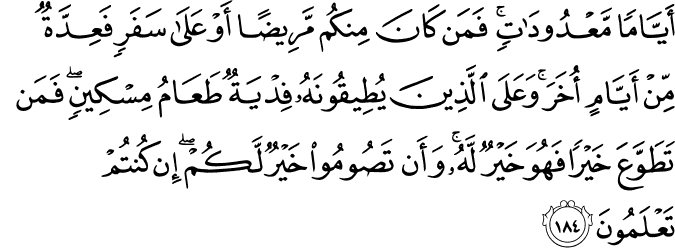
2:184
Transliteration
Ayyaman maAAdoodatin faman kanaminkum mareedan aw AAala safarin faAAiddatun minayyamin okhara waAAala allatheena yuteeqoonahufidyatun taAAamu miskeenin faman tatawwaAAakhayran fahuwa khayrun lahu waan tasoomoo khayrun lakum inkuntum taAAlamoon
Sahih International
[Fasting for] a limited number of days. So whoever among you is ill or on a journey [during them] - then an equal number of days [are to be made up]. And upon those who are able [to fast, but with hardship] - a ransom [as substitute] of feeding a poor person [each day]. And whoever volunteers excess - it is better for him. But to fast is best for you, if you only knew.
Yusuf Ali
(Fasting) for a fixed number of days; but if any of you is ill, or on a journey, the prescribed number (Should be made up) from days later. For those who can do it (With hardship), is a ransom, the feeding of one that is indigent. But he that will give more, of his own free will,- it is better for him. And it is better for you that ye fast, if ye only knew.
French
pendant un nombre déterminé de jours. Quiconque d'entre vous est malade ou en voyage, devra jeûner un nombre égal d'autres jours. Mais pour ceux qui ne pourraient le supporter (qu'avec grande difficulté), il y a une compensation : nourrir un pauvre. Et si quelqu'un fait plus de son propre gré, c'est pour lui; mais il est mieux pour vous de jeûner; si vous saviez !
Malay
(Puasa yang diwajibkan itu ialah beberapa hari yang tertentu; maka sesiapa di antara kamu yang sakit, atau dalam musafir, (bolehlah ia berbuka), kemudian wajiblah ia berpuasa sebanyak (hari yang dibuka) itu pada hari-hari yang lain; dan wajib atas orang-orang yang tidak terdaya berpuasa (kerana tua dan sebagainya) membayar fidyah iaitu memberi makan orang miskin. Maka sesiapa yang dengan sukarela memberikan (bayaran fidyah) lebih dari yang ditentukan itu, maka itu adalah suatu kebaikan baginya; dan (walaupun demikian) berpuasa itu lebih baik bagi kamu daripada memberi fidyah), kalau kamu mengetahui.
Thai
(คือ ถูกกำหนดให้ถือ) ในบรรดาวันที่ถูกนับไว้ แล้วผู้ใดในพวกเจ้าป่วยหรืออยู่ในการเดินทางก็ให้ถือใช้ในวันอื่น และหน้าที่ของบรรดาผู้ที่ถือศีลอดด้วยความลำบากยิ่ง (โดยที่เขาได้งดเว้นการถือ) นั้น คือการชดเชยอันได้แก่การให้อาหาร(มื้อหนึ่ง)แก่คนมิสกีนคนหนึ่ง (ต่อการงดเว้นจาการถือหนึ่งวัน) แต่ผู้กระทำความดีโดยสมัครใจ มันก็เป็นความดีแก่เขา และการที่พวกเจ้าจะถือศีลอดนั้น ย่อมเป็นสิ่งที่ดียิ่งกว่าพวกเจ้า หากพวกเจ้ารู้
Turkish
(Size farz kilinan oruç), sayili günlerdedir. Içinizden hasta olan veya yolculukta bulunan ise, diger günlerde, tutamadigi günler sayisinca tutar. Ona dayanip kalacaklar üzerine de bir yoksulu doyuracak kadar fidye gerekir. Her kim de hayrina fidyeyi artirirsa, hakkinda daha hayirlidir. Bununla beraber, eger bilirseniz, oruç tutmaniz sizin için daha hayirlidir.
Tamil NEW
(இவ்வாறு விதிக்கப் பெற்ற நோன்பு) சில குறிப்பட்ட நாட்களில் (கடமையாகும்) ஆனால் (அந்நாட்களில்) எவரேனும் நோயாளியாகவோ, அல்லது பயணத்திலோ இருந்தால் (அவர் அக்குறிப்பிட்ட நாட்களின் நோன்பைப்) பின்னால் வரும் நாட்களில் நோற்க வேண்டும்; எனினும்(கடுமையான நோய், முதுமை போன்ற காரணங்களினால்) நோன்பு நோற்பதைக் கடினமாகக் காண்பவர்கள் அதற்குப் பரிகாரமாக - ஃபித்யாவாக - ஒரு மிஸ்கீனுக்கு (ஏழைக்கு) உணவளிக்க வேண்டும்;. எனினும் எவரேனும் தாமாகவே அதிகமாகக் கொடுக்கிறாரோ அது அவருக்கு நல்லது - ஆயினும் நீங்கள் (நோன்பின் பலனை அறீவீர்களானால்), நீங்கள் நோன்பு நோற்பதே உங்களுக்கு நன்மையாகும் (என்பதை உணர்வீர்கள்).

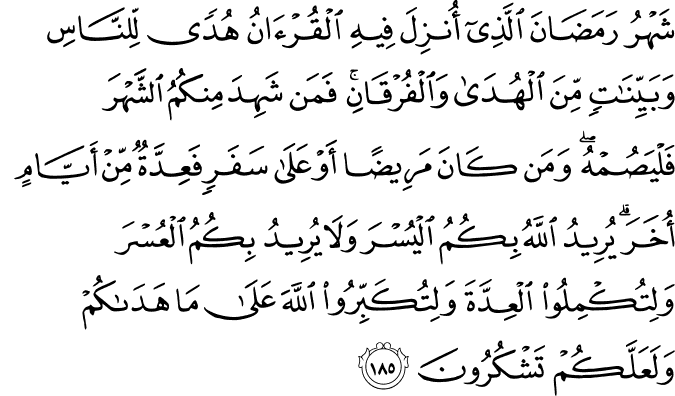
2:185
Transliteration
Shahru ramadana allatheeonzila feehi alqur-anu hudan linnasiwabayyinatin mina alhuda walfurqanifaman shahida minkumu ashshahra falyasumhu waman kanamareedan aw AAala safarin faAAiddatun min ayyaminokhara yureedu Allahu bikumu alyusra wala yureedubikumu alAAusra walitukmiloo alAAiddata walitukabbiroo AllahaAAala ma hadakum walaAAallakum tashkuroon
Sahih International
The month of Ramadhan [is that] in which was revealed the Qur'an, a guidance for the people and clear proofs of guidance and criterion. So whoever sights [the new moon of] the month, let him fast it; and whoever is ill or on a journey - then an equal number of other days. Allah intends for you ease and does not intend for you hardship and [wants] for you to complete the period and to glorify Allah for that [to] which He has guided you; and perhaps you will be grateful.
Yusuf Ali
Ramadhan is the (month) in which was sent down the Qur'an, as a guide to mankind, also clear (Signs) for guidance and judgment (Between right and wrong). So every one of you who is present (at his home) during that month should spend it in fasting, but if any one is ill, or on a journey, the prescribed period (Should be made up) by days later. Allah intends every facility for you; He does not want to put to difficulties. (He wants you) to complete the prescribed period, and to glorify Him in that He has guided you; and perchance ye shall be grateful.
French
(Ces jours sont) le mois de Ramadan au cours duquel le Coran a été descendu comme guide pour les gens, et preuves claires de la bonne direction et du discernement. Donc quiconque d'entre vous est présent en ce mois, qu'il jeûne ! Et quiconque est malade ou en voyage, alors qu'il jeûne un nombre égal d'autres jours. - Allah veut pour vous la facilité, Il ne veut pas la difficulté pour vous, afin que vous en complétiez le nombre et que vous proclamiez la grandeur d'Allah pour vous avoir guidés, et afin que vous soyez reconnaissants !
Malay
(Masa yang diwajibkan kamu berpuasa itu ialah) bulan Ramadan yang padanya diturunkan Al-Quran, menjadi petunjuk bagi sekalian manusia, dan menjadi keterangan-keterangan yang menjelaskan petunjuk dan (menjelaskan) perbezaan antara yang benar dengan yang salah. Oleh itu, sesiapa dari antara kamu yang menyaksikan anak bulan Ramadan (atau mengetahuinya), maka hendaklah ia berpuasa bulan itu; dan sesiapa yang sakit atau dalam musafir maka (bolehlah ia berbuka, Kemudian wajiblah ia berpuasa) sebanyak hari yang ditinggalkan itu pada hari-hari yang lain. (Dengan ketetapan yang demikian itu) Allah menghendaki kamu beroleh kemudahan, dan Ia tidak menghendaki kamu menanggung kesukaran. Dan juga supaya kamu cukupkan bilangan puasa (sebulan Ramadan), dan supaya kamu membesarkan Allah kerana mendapat petunjukNya, dan supaya kamu bersyukur.
Thai
เดือน รอมฏอนนั้น เป็นเดือนที่อัลกรุ-อานได้ถูกประทานลงมาในฐานะเป็นข้อแนะนำสำหรับมนุษย์ และเป็นหลักฐานอันชัดเจนเกี่ยวกับข้อแนะนำนั้น และเกี่ยวกับสิ่งที่จำแนกระหว่างความจริงกับความเท็จ ดังนั้นผู้ใดในหมูพวกเจ้าเข้าอยู่ในเดือนนั้นแล้ว ก็จงถือศีลอดในเดือนนั้น และผู้ใดป่วย หรืออยู่ในการเดินทาง ก็จงถือใช้ในวันอื่นแทน อัลลอฮ์ทรงประสงค์ให้มีความสะดวกแก่พวกเจ้า และไม่ทรงให้มีความลำบากแก่พวกเจ้าและเพื่อที่พวกเจ้าจะได้ให้ครบถ้วน ซึ่งจำนวนวัน(ของเดือนรอมฏอน) และเพื่อพวกเจ้าจะได้ให้ความเกรียงไกรแด่อัลลอฮ์ในสิ่งที่พระองค์ทรงแนะนำ แก่พวกเจ้า และเพื่อพวกเจ้าจะขอบคุณ
Turkish
O Ramazan ayi ki, insanlari irsad için, hak ile batili ayiracak olan, hidayet rehberi ve deliller halinde bulunan Kur'ân onda indirildi. Onun için sizden her kim bu aya sahit olursa onda oruç tutsun. Kim de hasta, yahut yolculukta ise tutamadigi günler sayisinca diger günlerde kaza etsin. Allah size kolaylik diler zorluk dilemez. Sayiyi tamamlamanizi, size dogru yolu gösterdiginden dolayi Allah'i tekbir etmenizi ister. Umulur ki sükredersiniz.
Tamil NEW
ரமளான் மாதம் எத்தகையதென்றால் அதில் தான் மனிதர்களுக்கு (முழுமையான வழிகாட்டியாகவும், தெளிவான சான்றுகளைக் கொண்டதாகவும்; (நன்மை - தீமைகளைப்) பிரித்தறிவிப்பதுமான அல் குர்ஆன் இறக்கியருளப் பெற்றது. ஆகவே, உங்களில் எவர் அம்மாதத்தை அடைகிறாரோ, அவர் அம்மாதம் நோன்பு நோற்க வேண்டும்;. எனினும் எவர் நோயாளியாகவோ அல்லது பயணத்திலோ இருக்கிறாரோ (அவர் அக்குறிப்பிட்ட நாட்களின் நோன்பைப்) பின்வரும் நாட்களில் நோற்க வேண்டும்;. அல்லாஹ் உங்களுக்கு இலகுவானதை நாடுகிறானே தவிர, உங்களுக்கு சிரமமானதை அவன் நாடவில்லை. குறிப்பிட்ட நாட்கள் (நோன்பில் விடுபட்டுப் போனதைப்) பூர்த்தி செய்யவும், உங்களுக்கு நேர்வழி காட்டியதற்காக அல்லாஹ்வின் மகத்துவத்தை நீங்கள் போற்றி நன்றி செலுத்துவதற்காகவுமே (அல்லாஹ் இதன் மூலம் நாடுகிறான்).

2:186
Transliteration
Wa-itha saalaka AAibadeeAAannee fa-innee qareebun ojeebu daAAwata addaAAiitha daAAani falyastajeeboo lee walyu/minoo beelaAAallahum yarshudoon
Sahih International
And when My servants ask you, [O Muhammad], concerning Me - indeed I am near. I respond to the invocation of the supplicant when he calls upon Me. So let them respond to Me [by obedience] and believe in Me that they may be [rightly] guided.
Yusuf Ali
When My servants ask thee concerning Me, I am indeed close (to them): I listen to the prayer of every suppliant when he calleth on Me: Let them also, with a will, Listen to My call, and believe in Me: That they may walk in the right way.
French
Et quand Mes serviteurs t'interrogent sur Moi.. alors Je suis tout proche : Je réponds à l'appel de celui qui Me prie quand il Me prie. Qu'ils répondent à Mon appel, et qu'ils croient en Moi, afin qu'ils soient bien guidés.
Malay
Dan apabila hamba-hambaKu bertanya kepadamu mengenai Aku maka (beritahu kepada mereka): sesungguhnya Aku (Allah) sentiasa hampir (kepada mereka); Aku perkenankan permohonan orang yang berdoa apabila ia berdoa kepadaKu. Maka hendaklah mereka menyahut seruanku (dengan mematuhi perintahKu), dan hendaklah mereka beriman kepadaKu supaya mereka menjadi baik serta betul.
Thai
และ เมื่อบ่าวของข้าถามเจ้าถึงข้าแล้วก็ (จงตอบเถิดว่า) แท้จริงนั้นอยู่ใกล้ ข้าจะตอบรับคำวิงวอนของผู้ที่วิงวอน เมื่อเขาวิงวอนต่อข้าดังนั้น พวกเขาจงตอบรับข้าเถิด และศรัทธาต่อข้า เพื่อว่าพวกเขาจะได้อยู่ในทางที่ถูกต้อง
Turkish
Sayet kullarim, sana benden sordularsa, gerçekten ben çok yakinimdir. Bana dua edince, duacinin duasini kabul ederim. O halde onlar da benim davetime kossunlar ve bana hakkiyla iman etsinler ki, dogru yola gidebilsinler.
Tamil NEW
(நபியே!) என் அடியார்கள் என்னைப்பற்றி உம்மிடம் கேட்டால்; "நிச்சயமாக நான் சமீபமாகவே இருக்கிறேன், பிரார்த்தனை செய்பவரின் பிரார்த்தனைக்கு அவர் பிரார்த்தித்தால் விடையளிக்கிறேன்;, அவர்கள் என்னிடமே(பிரார்த்தித்துக்) கேட்கட்டும்;, என்னை நம்பட்டும். அப்பொழுது அவர்கள் நேர்வழியை அடைவார்கள்" என்று கூறுவீராக.

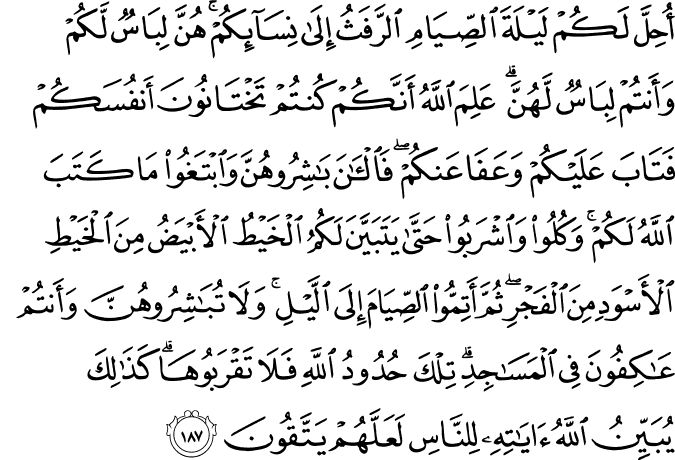
2:187
Transliteration
Ohilla lakum laylata assiyamiarrafathu ila nisa-ikum hunna libasunlakum waantum libasun lahunna AAalima Allahuannakum kuntum takhtanoona anfusakum fatabaAAalaykum waAAafa AAankum fal-ana bashiroohunnawabtaghoo ma kataba Allahu lakum wakuloo washraboohatta yatabayyana lakumu alkhaytu al-abyadumina alkhayti al-aswadi mina alfajri thumma atimmoo assiyamaila allayli wala tubashiroohunna waantum AAakifoonafee almasajidi tilka hudoodu Allahi falataqrabooha kathalika yubayyinu Allahu ayatihilinnasi laAAallahum yattaqoon
Sahih International
It has been made permissible for you the night preceding fasting to go to your wives [for sexual relations]. They are clothing for you and you are clothing for them. Allah knows that you used to deceive yourselves, so He accepted your repentance and forgave you. So now, have relations with them and seek that which Allah has decreed for you. And eat and drink until the white thread of dawn becomes distinct to you from the black thread [of night]. Then complete the fast until the sunset. And do not have relations with them as long as you are staying for worship in the mosques. These are the limits [set by] Allah , so do not approach them. Thus does Allah make clear His ordinances to the people that they may become righteous.
Yusuf Ali
Permitted to you, on the night of the fasts, is the approach to your wives. They are your garments and ye are their garments. Allah knoweth what ye used to do secretly among yourselves; but Heturned to you and forgave you; so now associate with them, and seek what Allah Hath ordained for you, and eat and drink, until the white thread of dawn appear to you distinct from its black thread; then complete your fast Till the night appears; but do not associate with your wives while ye are in retreat in the mosques. Those are Limits (set by) Allah: Approach not nigh thereto. Thus doth Allah make clear His Signs to men: that they may learn self-restraint.
French
On vous a permis, la nuit d'as-Siyam, d'avoir des rapports avec vos femmes; elles sont un vêtement pour vous et vous un vêtement pour elles. Allah sait que vous aviez clandestinement des rapports avec vos femmes. Il vous a pardonné et vous a graciés. Cohabitez donc avec elles, maintenant, et cherchez ce qu'Allah a prescrit en votre faveur; mangez et buvez jusqu'à ce que se distingue, pour vous, le fil blanc de l'aube du fil noir de la nuit . Puis accomplissez le jeûne jusqu'à la nuit. Mais ne cohabitez pas avec elles pendant que vous êtes en retraite rituelle dans les mosquées. Voilà les lois d'Allah : ne vous en approchez donc pas (pour les transgresser).C'est ainsi qu'Allah expose aux hommes Ses enseignements, afin qu'ils deviennent pieux.
Malay
Dihalalkan bagi kamu, pada malam hari puasa, bercampur (bersetubuh) dengan isteri-isteri kamu. Isteri-isteri kamu itu adalah sebagai pakaian bagi kamu dan kamu pula sebagai pakaian bagi mereka. Allah mengetahui bahawasanya kamu mengkhianati diri sendiri, lalu Ia menerima taubat kamu dan memaafkan kamu. Maka sekarang setubuhilah isteri-isteri kamu dan carilah apa-apa yang telah ditetapkan oleh Allah bagi kamu; dan makanlah serta minumlah sehingga nyata kepada kamu benang putih (cahaya siang) dari benang hitam kegelapan malam), iaitu waktu fajar. Kemudian sempurnakanlah puasa itu sehingga waktu malam (maghrib); dan janganlah kamu setubuhi isteri-isteri kamu ketika kamu sedang beriktikaf di masjid. Itulah batas-batas larangan Allah, maka janganlah kamu menghampirinya. Demikian Allah menerangkan ayat-ayat hukumNya kepada sekalian manusia supaya mereka bertaqwa.
Thai
ได้ เป็นที่อนุมัติแก่พวกเจ้าแล้ว ซึ่งการสมสู่กับบรรดาภรรยาของพวกเจ้าในค่ำคืนของการถือศีลอด นางทั้งหลายนั้นคือเครื่องนุ่งห่มของพวกเจ้า และพวกเจ้าก็คือเครื่องนุ่งห่มของพวกนาง อัลลอฮ์ทรงรู้ว่า พวกเจ้านั้นเคยทุจริตต่อตัวเอง แล้วพระองค์ก็ทรงยกโทษให้แก่พวกเจ้า และอภัยให้แก่พวกเจ้าแล้ว บัดนี้พวกเจ้าสมสู่กับพวกนางได้ และแสวงหาสิ่งที่อัลลอฮ์ได้ทรงกำหนดให้แก่พวกเจ้าเถิด และจงกิน และดื่ม จนกระทั่งเส้นขาว จะประจักษ์แก่พวกเจ้า จากเส้นดำ เนื่องจากแสงรุ่งอรุณ แล้วพวกเจ้าจงให้การถือศีลอดครบเต็มจนถึงพลบค่ำ และพวกเจ้าจงอย่าสมสู่กับพวกนางขณะที่พวกเจ้าเอียะติก๊าฟ อยู่ในมัสยิด นั่นคือบรรดาขอบเขตของอัลลอฮ์ดังนั้นพวกเจ้าจงอย่าเข้าใกล้ขอบเขตนั้น ในทำนองนั้นแหละอัลลอฮ์จะทรงแจกแจงบรรดาโองการของพระองค์แก่มนุษย์ เพื่อว่าพวกเขาจะได้ยำเกรง
Turkish
Oruç gecesi kadinlariniza yaklasmaniz, size helâl kilindi. Onlar, sizin için bir örtü, siz de onlar için bir örtü durumundasiniz. Allah, nefsinize güvenemeyeceginizi bildigi için müracaatinizi kabul buyurdu ve sizi bagisladi. Simdi onlara yaklasin ve Allah'in sizler için yazdigini isteyin. Ta fecrin beyaz ipligi siyah iplikden size seçilinceye kadar yiyin, için. Sonra da ertesi geceye kadar orucu tam tutun. Bununla beraber siz mescitlerde îtikaf halinde iken onlara yaklasmayin. Bunlar, Allah'in sinirlaridir, sakin onlara yaklasmayin. Allah, âyetlerini insanlara böyle açikliyor ki sakinip korunsunlar.
Tamil NEW
நோன்புக் கால இரவில் நீங்கள் உங்கள் மனைவியருடன் கூடுவது உங்களுக்கு அனுமதிக்கப் பட்டுள்ளது. அவர்கள் உங்களுக்கு ஆடையாகவும், நீங்கள் அவர்களுக்கு ஆடையாகவும் இருக்கின்றீர்கள்;. நீங்கள் இரகசியமாகத் தம்மைத் தாமே வஞ்சித்துக் கொண்டிருந்ததை அல்லாஹ் நன்கறிவான்;. அவன் உங்கள் மீது இரக்கங்கொண்டு உங்களை மன்னித்தான்;. எனவே, இனி(நோன்பு இரவுகளில்) உங்கள் மனைவியருடன் கூடி அல்லாஹ் உங்களுக்கு விதித்ததை தேடிக்கொள்ளுங்கள்;. இன்னும் ஃபஜ்ரு (அதிகாலை)நேரம் என்ற வெள்ளை நூல்(இரவு என்ற) கருப்பு நூலிலிருந்து தெளிவாகத் தெரியும் வரை உண்ணுங்கள், பருகுங்கள்;. பின்னர், இரவு வரும் வரை நோன்பைப் பூர்த்தி செய்யுங்கள்; இன்னும் நீங்கள் பள்ளிவாசலில் தனித்து (இஃதிகாஃபில்) இருக்கும் போது, உங்கள் மனைவியருடன் கூடாதீர்கள் - இவையே அல்லாஹ் விதித்த வரம்புகளாகும்;. அந்த வரம்புகளை(த் தாண்ட) முற்படாதீர்கள்;. இவ்வாறே (கட்டுப்பாடுடன்) தங்களைக்காத்து பயபக்தியுடையோர் ஆவதற்காக அல்லாஹ் தன்னுடைய சான்றுகளைத் தெளிவாக்குகின்றான்.

2:188
Transliteration
Wala ta/kuloo amwalakumbaynakum bilbatili watudloo biha ilaalhukkami lita/kuloo fareeqan min amwali annasibil-ithmi waantum taAAlamoon
Sahih International
And do not consume one another's wealth unjustly or send it [in bribery] to the rulers in order that [they might aid] you [to] consume a portion of the wealth of the people in sin, while you know [it is unlawful].
Yusuf Ali
And do not eat up your property among yourselves for vanities, nor use it as bait for the judges, with intent that ye may eat up wrongfully and knowingly a little of (other) people's property.
French
Et ne dévorez pas mutuellement et illicitement vos biens, et ne vous en servez pas pour corrompre des juges pour vous permettre de dévorer une partie des biens des gens, injustement et sciemment.
Malay
Dan janganlah kamu makan (atau mengambil) harta (orang-orang lain) di antara kamu dengan jalan yang salah, dan jangan pula kamu menghulurkan harta kamu (memberi rasuah) kepada hakim-hakim kerana hendak memakan (atau mengambil) sebahagian dari harta manusia dengan (berbuat) dosa, padahal kamu mengetahui (salahnya).
Thai
และ พวกเจ้าจงอย่ากินทรัพย์ สมบัติของพวกเจ้า ระหว่างพวกเจ้าโดยมิชอบ และจงอย่าจ่ายมัน ให้แก่ผู้พิพากษา เพื่อที่พวกเจ้าจะได้กินส่วนหนึ่งจากทรัพย์สินสมบัติของผู้อื่น ด้วยการกระทำสิ่งที่เป็นบาป ทั้งๆ ที่พวกเจ้ารู้กันอยู่
Turkish
Bir de aranizda mallarinizi batil sebeplerle yemeyin. Insanlarin mallarindan bir kismini bile bile günah ile yemek için, o mallari hakimlere rüsvet olarak vermeyin.
Tamil NEW
அன்றியும், உங்களுக்கிடையில் ஒருவர் மற்றவரின் பொருளைத் தவறான முறையில் சாப்பிடாதீர்கள்;. மேலும், நீங்கள் அறிந்து கொண்டே பிற மக்களின் பொருள்களிலிருந்து(எந்த) ஒரு பகுதியையும், அநியாயமாகத் தின்பதற்காக அதிகாரிகளிடம் (இலஞ்சம் கொடுக்க) நெருங்காதீர்கள்.
Copyright © Quran.com. All rights reserved.

Friday, August 27, 2010

A Journey to Happiness – Ep1


Episode 1

In the name of Allah[1], The All-Merciful, The Ever-Merciful, praise be upon Him, and peace be upon the Messenger of Allah (SAWS[2]). Welcome and Ramadan Kareem.

Our program this year is quite different from all the previous ones. It is “A Journey to Happiness”. We will go on a trip for thirty days; thirty days of moving from place to place. We are shooting in Lebanon; among the mountains, the sea, and the rivers. We are living the journey, that’s why we did not film in a studio because we want to feel the sense of the trip. The goal of this trip is happiness. How to be happy in this world? Today, people are suffering from problems, sorrows, pain, disease, financial distress, delayed marriage, delayed employment, fatigue, etc. Can we, with ideas, with faith, with a new way of thinking, with a stronger moral, overcome many problems and face the financial and material problems that we were unable to face previously because we had a weaker soul. This is what our program is about this year. Multiple recipes, an integrated package and not separate recipes. Seven sets and if you live by them you will live happily.

However, today's episode does not speak about any of this. We will not talk about any of the seven sets. The first episode is the introduction. In our first episode, we will only deal with two words:  “journey”  and  “happiness”. Before we begin the journey that we will launch tomorrow, by Allah’s will, we just have to agree on these two words.

Pay close attention because this will be the base for all our coming talk!  I would like, first, to ask all young men and women watching us to start by preparing a notebook. We shall call this, “The Notebook of the Journey to Happiness”. We will write so many things but let's start with the word, “journey”.

What do I mean by this word? I mean your journey and mine in this life. Let us agree on a basic fact about this trip. It is a short trip; a very short one, in fact. I have to mention this because I will speak to you later about death, problems and pain, so, at the outset I must remind you that it is very short. The trip is not as long as you see it, or as portrayed and exaggerated to us.

There is an idea that says that a man lives in five stages:

  • Stage 1:  The Creation Stage: When Allah created all before the start of all mankind, He said what can be translated as “And (remember) as your Lord took from the Seeds (Or. sons) of Adam, from their backs, their offspring, and made them bear witness concerning themselves, ‘Am I not your Lord?’ They said, ‘Yes indeed, we bear witness.’ (So) that you should not say on the Day of the Resurrection, ‘Surely we were heedless of this,’” (TMQ[3], 7:172). 

  • Stage 2: The Generation: From your earliest grandfather down to your mother and father, and then to you when you arrive in life.

  • Stage 3: Your Life in this World: The 60 to 70 years you will spend here.

  • Stage 4: The Grave: The life of the isthmus, which we do not know anything about. The grave is either one of the gardens of Jannah or one of the pits of hellfire.

  • Stage 5: The Hereafter: Jannah or Hell, jannah by Allah’s will.

The shortest of them is your life in this world. The 60-70 years, while the Creation Stage was too long, and the grave, we do not know its duration, and jannah? ... It's infinity. So life is too short and the world that follows it is too long. We were taught in mathematics, that if any number is divided by infinity the result is zero. If you live in this world for one hundred years and possess all its treasures and enjoyed them, when you divide it by infinity, you will get zero.

In this world no one will continue to move up. Everything has to go up and down. The Prophet (SAWS) had a camel named al-Qasswa’ which no camel could outrun. One day, a simple Bedouin came with his camel and beat al-Qasswa’. The Companions were indignant. The Messenger of Allah (SAWS) told them that Allah asserts the rule that everything in this world which goes up must come down. The whole world does not equal the weight of a mosquito’s wing in Allah’s calculations. If this world, with everything in it, is not equivalent to a mosquito’s wing, then what do you; with all your possessions add up to? Let us see this world for its true value. No matter what your pains, sorrows and sufferings are in this world, see them in their true size.

This is the first fact that we will agree on: All the pain and sufferings, wealth and appearances are there for a short period. The short journey is not worth the sadness. No matter how great is your pain, it will pass.

The second word we will agree on is: “happiness”.

Let us agree that there is no full happiness in this world; there must be discomfort and pain. In fact, every movement in this world is done in search of happiness. The search for funds; money is only papers but its value comes from its ability to bring more happiness. Same goes to love, children, glory, reputation, etc. Complete happiness is only in jannah. Our movement and acts in this world is only a test for us, as Allah says what can be translated as, “to try you, whichever of you is fairest in deeds” (TMQ, 67:2) to see who deserves it and who does not.

As long as we talk about happiness, let us imagine that we have entered jannah. Imagine that you are now on the Day of Judgment, and you passed successfully all the required stages. Now you are passing on as-siraat[4] and you crossed it safely. You are now at the gate of Jannah. They once asked one of the followers, “When can you be assured of entering jannah?” He replied, “When as-siraat is behind you. If it is behind you, then you are one of the people of jannah.” Try to imagine the shape of the gate, its size, color. Imagine the company around you: the blessed Prophet, his companions, the previous prophets, and the angels. The angels will greet you and welcome you, as VIP visitors were welcomed in this world. The greeting of the angels at the gate of Jannah is different. As Allah says what can be translated as, “And the ones who were pious to their Lord will be driven in hordes to the Garden till when they have come to it, and its gates will be opened, and its Keepers will say to them, ‘Peace be upon you! You have been good, so enter (into) it eternally (abiding)’” (TMQ, 39:73).

Try to imagine such a reception at jannah. Now let us see in any of the rows in front of jannah you are standing: Front or back? Imagine yourself standing in the back rows, and the Prophet (SAWS) comes to take your hand to the front ones, next to him (SAWS) because you were one of those who cared for orphans and he (SAWS) told us that he who will do so will be very close to him in jannah. Or because you were an ethical person, as he (SAWS) is reported to have said that the closest one to him on the Day of Judgment will be the one with the finest ethics. Then you find yourself in the front rows despite your late arrival and due to the goodness of your acts.

Now everyone stands in front of the gate waiting for it to open, and here comes the Prophet (SAWS) to open it. He (SAWS) knocks at the gate and the jannah’s gate-keeper refuses to open except to Prophet Muhammed (SAWS) as Allah (SWT) commanded him. The gate then finally opens. Try to imagine the scene. The Prophet (SAWS) is reported to have said that the size of the gate to Jannah when opened equals the distance between Mecca and Syria!!! Jannah itself is equal to both the skies and earth, so imagine the size of its gate. Try and smell the fragrance of jannah. The Prophet (SAWS) is reported to have said that the smell of jannah can be detected five hundred years away.

Now you are standing at its gate, and it is open. Before entering, Allah, The Almighty will address the people of jannah and offer them four things: to be always well, and never fall sick; to be always youthful, and never age; to be always alive, and never die; and to be always happy, and never be sad again. The word grief is erased forever; you are only left with happiness. Then before entering you will go through a river called, “The River of Life”. This is the real “life”. You will wash in this river and the malice in your heart is taken away. There is no longer anger, hate, or envy, only love and peace and goodness and tenderness. Then you enter jannah.

Imagine Allah (SWT) is calling to you and telling you that He has prepared for His righteous slaves, what no eye has seen; what no ear has heard nor the heart of man ever did imagine. We usually associate our expectations of a gift with the one offering it. For example, if you are promised a sum of money by a child you will expect it smaller than if it is promised by a bank manager. The sum expected from a president is larger. Now, what can we expect if Allah, the Lord of the Worlds, The King of all Kings is the one offering this gift?

Note that the order of the senses: eye, ear then heart is significant, because what you have seen is less than what you have heard about and for sure you have neither seen nor heard as much as your mind or heart has conjured up in imagination. Also note that Allah does not say that He ordered the angels to prepare it, He prepared it by Himself for those entering jannah. What is prepared by the Almighty? How great can it be?

Imagine yourself taken by the hand of the Prophet (SAWS) to be shown to your palace. He (SAWS) is holding your hand because he is happy with you and your good deeds which were shown to him by the angels every Thursday during your earthly life.  Imagine that your palace is in front of the palace of the Prophet (SAWS); you are the neighbor and companion of the Prophet (SAWS) in jannah as a reward for the short journey (life) when you were tired but endured it and its pains patiently. The Prophet (SAWS) is reported to have described the jannah’s palaces to have a brick of gold and a brick of silver, they are held together with musk and their floors are made of pearls and their roof is the throne of The All-Merciful. The Prophet (SAWS) described the combs of the dwellers of jannah as made of gold, their sweat as musk. They are inspired to praise the glories of Allah, as we are inspired to breathe. Then imagine the space of your palace in jannah. The Prophet (SAWS) is reported to have said that the one occupying the lowest rank in jannah has a palace so big that he will walk a thousand years without reaching its end. The Companions then asked him (SAWS) if this is the lowest ranking then what about the highest ranking? He (SAWS) replied that the highest ranking looks directly at Allah (SWT) morning and night. Allah said that wherever you will look in jannah you will see blessings, you will become a king. You were poor and weak but it was just a short journey, you are today in complete happiness, blessed and with a great kingdom.

The sweetest thing that will happen in heaven is when Allah speaks to you and tells you that He is pleased with you then asks you if you are satisfied with Him and with jannah. Imagine this and you ask Him to look upon His Face, and imagine that all blocks are torn down and that you can see Him as you can see the full moon. The Messenger of Allah (SAWS) says that this is the greatest pleasure they are given in jannah.

A Journey to Happiness is a short trip we take to get to the happiness in the hereafter. I do not say we bear the fatigue and misery in this world waiting for the blessings of the hereafter; this is not true, just like those who claim that religion is the opium of the people. In fact, the Prophet (SAWS) never mentioned jannah and the success in the hereafter without mentioning the way of success in this world. Jannah is a means to success in this world and not a drug. To the contrary, the Prophet (SAWS) used jannah as a reform for life. He who walks a road seeking knowledge will be guaranteed an easy road to jannah by Allah; if you want to succeed, learn. Jannah is under the feet of mothers. Pleasing your mother is a road to heaven. He who is patient for losing his eyesight will enter jannah. All these are examples of ways for us to enter jannah through our deeds in this world.

Today we have agreed on these two facts: (1) That life is a short trip, (2) That complete happiness is only possible in the hereafter. As of tomorrow we will start our journey; we will try to learn patience, determination, prayer, get closer to Allah. We will focus on the religious, psychological, spiritual, and mental aspects so that we can face our problems; the material problems being greater. We will solve our problems and be happy in this world on our journey to happiness.

AmrKhaled.net ©© All rights reserved جميع حقوق النشر محفوظة
This Article may be published and duplicated freely for private purposes, as long as the original source is mentioned. For all other purposes you need to obtain the prior written approval of the website administration.  For info:
management@daraltarjama.com


[1] The word Allah is the Arabic term for God. Although the use of the word "Allah" is most often associated with Islam, it is not used exclusively by Muslims; Arab Christians and Arabic-speaking Jews also use it to refer to the One God. The Arabic word expresses the unique characteristics of the One God more precisely than the English term. Whereas the word "Allah" has no plural form in Arabic, the English form does. Allah is the God worshipped by all Prophets, from Adam to Noah, Abraham, Moses, Jesus and Muhammad.
[2] SAWS: Salla Allah alayhe Wa Salam [All Prayers and Peace of Allah be upon him]
[3] TMQ=Translation of the Meaning of the Qur'an.  This translation is for the realized meaning, so far, of the stated (Surah:Ayah) of the Qur'an.  Reading the translated meaning of the Qur'an can never replace reading it in Arabic, the language in which it was revealed.
[4] As-siraat: This word means path or way but in this context it refers to a narrow path that every person needs to cross on the Day of Judgment; a kind of test. Once, a person succeeds in crossing it, he or she is allowed into jannah (Paradise). Success in crossing as-siraat is dependent on many things; among these things are a person’s good deeds and Allah’s mercy.

Source: http://amrkhaled.net/newsite/languages.php?articleID=NTg4OA==&id=5888

Thursday, August 26, 2010

Jabeen Interview on TV Channel in Dubai about Ramadan


  To see Episode 26 - City Wrap - Dubai TV - Dubai Media

Jabeen Interview on TV Channel in Dubai about Ramadan

About traditions during Ramadan in South India how  Muslims celebrate this Holy month.
please click here : http://www.dubaimedia.ae/Media/view/77765

About traditions during Ramadan in South India how  Muslims celebrate this Holy month.


Tuesday, August 24, 2010

Episode 26 - City Wrap - Dubai TV - Dubai Media


please click here  Episode 26 - City Wrap - Dubai TV - Dubai Media

Join Lubna and Annah tonight as they chat to Souad Al Serkal from the SMCCU about traditions during Ramadan and we globe trek across to South India to find out how other Muslims celebrate this Holy month.


Saturday, August 21, 2010

Hadith: Ramadan

Hadith: Ramadan: "


Narrated by Abu Huraira (RA): I heard Allah’s Apostle (peace be upon him) saying regarding Ramadan, “Whoever prayed at night in it (the month of Ramadan) out of sincere Faith and hoping for a reward from Allah, then all his previous sins will be forgiven.”[Bukhari Volume 3, Book 32, Number 226]


"

I'TIKAAF (spiritual retirement)


I’tikaaf (spiritual retirement)


                                                               seychlles mosque 

 Allah soub’haanahu-wa-ta’ala (glory to him) tells us in the holy Koran: « And don’t have any relation relation with them (your wives) whilst you are in spiritual retirement in the mosques. These are the limits of Allah, do not go beyond them. It is in this way that Allah explains his signs to mankind so that they fear ». [Sourah 2, Verse 187].


The I’tikaaf means, to perform a spiritual retirement with the intention to do ibaadats of Allah and think about him. Men do it in Masjids (Mosques) and ladies at home in a room or a corner reserved usually for ‘ibaadats.


Hadith: Hazrat ‘Aysha Siddeeqa (r.a) reports that the beloved Prophet of Allah used to observe I’tikaaf during the last 10 (ten) days of the month of Ramadwaan. [Bukhaari – Muslim – Mishkaat).


Hazrat Imaam Husseyn (r.a) said that the one who accomplish 10 days of I’tikaaf during Ramadwaan, will gain thawaabs (rewards) of 2 hajj and 2 umrahs. (Bayhaqi).


There are three (3) kinds of I’tikaaf: Waajib, Sunnat-Mu’akadda-kifaayah and Mustahab.


I’tikaaf Waajib


This is when one makes a promise. If someone makes a “mannat” (a promise) for example to accomplish 3 days of I’tikaaf when his child would recover from a sickness. As soon as the child is cured, the person will have to accomplish this I’tikaaf in a Waajib way (compulsory).


For this I’tikaaf, the roza must also be observed, even if the person did not make the intention (niyyat) of roza in his promise (mannat). So, without roza, we have not the right to observe the Itikaaf-waajib.


I’tikaaf Sunnat-Mu’akadda-kifaayah


This is commonly the I’tikaaf of the majority of people who observe it during the 10 last days of the holy month of Ramadwaan. It is a sunnah (principle) of our beloved Prophet Muhammad and Muakaddah means that he never neglect it (he did it regularly).


Kifaayah means that if in a place (locality or commune), there is no one to observe the I‘tikaaf in the last tend ays of Ramadwaan, all the inhabitants of that locality would become sinners (gunehgaars). So, if one person among them do it, all the other inhabitants of that place will be free from that responsibility. This I’tikaaf is performed in the last ten days of Ramadwaan, thai is in the last third.


On the 20th day of Ramadwaan, before sunset, the muttakif must already have “entered” in the masjid (mosque) with niyyat. Normally people take the precaution to be there for the namaz Assar and build up their “daera” (a corner reserved for the muttakif). In the case that the niyyat is done after the namaz Maghrib (of that 20th day of Ramadwaan) I’tikaaf will not be valid as Sunnat-Mu’akaddah-Kifaayah.

For that I’tikaaf also the roza is necessary (obligatory).


I’tikaaf Mustahab


Apart from the I’tikaaf waajib and l’itikaaf Sunnat-Mu’akaddah-Kifaayah, the other I’tikaaf is called Mustahab. We do it when we are in the mosque.


Masla 1: The I’tikaaf Mustahab is done at any time we enter any masid to spend some time, since each time we enter the masjid, our time in is considered as a spiritual moment. The roza is not obligatory for the I’tikaaf mustahab. As soon as we get out of the mosque, this I’tikaaf ends. Without any special step and simply while doing this niyyat, we obtain this thawaab when we enter the mosque. It is thus advised to write this niyyat at the entrance of the masjid for everybody to read it while entering the masjid, can take profit of these thawaabs of I’tikaaf Mustahab.


Masla 2: ladies can observe the i’tikaaf, not at the mosque but at home. In this case, the I’tikaaf must be done in a special room usually reserved for ‘ibaadats or in a corner of the house where we usually do namaz and other ‘ibaadats. We call this room or corner “Masjid-il-bayt” (the mosque of the house). The Masjid-il-bayt must be fixed in a clean and respected place of the house.


Masla 3: If a lady has no special place to do namaz regularly, she cannot accomplish the I’tikaaf. But if she decide to look and fix a permanent place for namaz, then she will be able to accomplish the I’tikaaf. That lady must indeed be paak (that is out of her period of hayzz or nifaass).


Masla 4: The roza is necessary for I’tikaaf Sunnat-Mu’akaddah. So if somebody is sick or if a traveller (musaafir) observes this I’tikaaf and is not roza, then his I’tikaaf will be considered not as Sunnat-Mu’akaddah-Kifaayah but as Mustahab.


Masla 5: It is forbidden (haraam) for the one who accomplish the I’tikaaf waajib or sunnat to step out of the masjid without any valid reason (according to shariat).


In that case his i’tikaaf is cancelled, even he steps out by lapse of memory. Same thing for the ladies who leave their “place” any valid reason (according to shariat), even by lapse of memory.


Masla 6: There are two (2) valid occasions according to the shariah that the muttakif (man or woman) can get out of his “daera”.


1- For his toilets need, the ghussal (if it becomes obligatory) and the wazou.


2- For a necessity such as to give the azaan or accomplish the namaz in jama’at (for men).


Apart from these 2 reasons, whatever the reason for which a muttakif happen to get out, his I’tikaaf will be cancelled.


Masla 7: The muttakif who gets out for his toilets need must come back (to his daera) as soon as he finished.


Masla 8: If the ghusal or wazou of the muttakif is cancelled, he must do it immediately (to do the tayammum before leaving the daera) without waiting.


Masla 9: If a muttakif get out (of his daera) to go rescue an injured person, a burned person, a drown or even to go visit a sick person or to accomplish the namaz janaazah, his I’tikaaf is cancelled.


Masla 10: A muttakif must stay day and night in his daera. He eats, drinks and sleeps in it. He must keep it clean.


Masla 11: The muttakif must be permanently in ‘ibaadat. He must neither talk not keep silent. He must do ‘ibaadats, such as tilaawat (lecture) of the holy Koran, Darood shareef, wazifahs (recitations), study hadiths, study the life of our beloved Prophet and the other pious (swaliheen), read on religion (deen) and perform namaz nafil. Many people do (or want to do) the namazs nafils without worrying about namaz faraz they missed since their age of puberty (baaligh). They must know that nafils are not accepted as long as missed faraz are not replaced (qazaa umri).


Masla 12: If someone cancels the i’tikaaf Mu’akaddah or waajib voluntarily or involuntarily (beginning of hayzz or nifaas, becomes mad or lose conciousness) he will have to do the qazaa to replace the number of missed days only. It is not necessary to do again the 10 days.


Masla 13: There is no qazaa (replacement) for the I’tikaaf mustahab.


Masla 14: Many muttakifs write messages on a piece of paper to give to people in order to ask what they need. This is a useless practice because a muttakif has the right to talk in case of necessity or emergency.

Source : http://chezdeen.com/eng/

LinkWithin

Related Posts with Thumbnails