Historic and culturally important landmarks are being destroyed to make way for luxury hotels and malls, reports Jerome Taylor
Saturday, 24 September 2011
Behind closed doors – in places where the religious
police cannot listen in – residents of Mecca are beginning to refer to
their city as Las Vegas, and the moniker is not a compliment.
Over the past 10 years the holiest site in Islam has undergone a huge
transformation, one that has divided opinion among Muslims all over the
world.
Once a dusty desert town struggling to cope with the ever-increasing number of
pilgrims arriving for the annual Hajj, the city now soars above its
surroundings with a glittering array of skyscrapers, shopping malls and
luxury hotels.
To the al-Saud monarchy, Mecca is their vision of the future – a steel and
concrete metropolis built on the proceeds of enormous oil wealth that
showcases their national pride.
Ataullah Siddiqui investigates the history of Islam in Britain and explores the challenges facing the Muslim community today.
This article will discuss in brief the early immigration of Muslims into Britain. It traces the contributing factors for such immigration and discusses the problems faced by early immigrants. It analyses immigrants’ initiatives to live as Muslims and their encounters with other faiths, especially Christianity. Finally, the article highlights some of the contemporary problems faced by the community living in Britain.
Development of the Community
Although Muslim migration to Britain began from the mid nineteenth century, the immediate opportunity was brought about in 1869 by the opening of the Suez Canal. This facilitated increased trade between Britain and its colonies, and a contingent force of labourers to work on the ships and in the ports. The obvious choice of such labourers were the Yemenis. They were the first group of Muslim migrants who arrived at the British ports of Cardiff, Liverpool, Pollockshields and London. Between 1890-1903, nearly forty thousand seaman arrived on British shores and about thirty thousand of them, according to one report, spent some part of their lives in Britain.
Inevitably, there was a language barrier between the Yemeni workers and their British employers. This, the Yemenis solved in tribal fashion. Yemeni workers, upon their arrival at British ports, assigned themselves to a particular leader for their daily needs and work requirements. The leaders were usually chosen because of their relatively better communication skills, and their awareness of employers’ needs and government requirements. Sometimes this transit period could be extended by months, and this could be a very difficult time for Yemeni sailors. Bit by bit, some of them began to settle for longer periods and married local British girls. In port cities like Cardiff and Liverpool, there are now several generations of Muslims in the community.
Additionally there were others who migrated and settled in Britain. Civil servants of the British Raj used to visit Britain either to acquire work experience or to take civil service examination in order to gain promotion in their jobs. A small number of them settled in Britain. People such as Abdullah Yusuf Ali, a civil servant and translator of the Qur’an into English, lived, married and died in Britain.
On the one hand, then, we have the British Empire, which attracted increasing numbers of immigrants to Britain, whilst on the other, we have native Britons who were attracted to the faith and beliefs of these immigrants. Pursuant to their regular visits to Muslim countries, these Britons were attracted by the mystical dimension of Islam. Others came into contact with Muslim professionals and students in Britain because they mingled with the British aristocracy; they shared a similar background. These two factors played an important role in establishing Islam in Britain.
During the latter part of the last century and until the beginning of the Second World War, two key institutions emerged, one in Liverpool and the other in Surrey. William H Quilliam, a lawyer in Liverpool, visited Morocco in 1887. There he was attracted to Islam, and soon became a Muslim, founding The Liverpool Mosque and The Muslim Institute. He edited The Islamic World (begun in 1890) and The Crescent, a weekly publication in which he wrote extensively about Islam and Muslims. A number of tracts were also published. Quilliam also established Madina House, a house for orphans in Liverpool. His works attracted both Muslims and non-Muslims alike and also seem to have had a lasting audience abroad. He received a personal gift from the Amir of Afghanistan and the Ottoman Sultan invited him to visit Istanbul and soon appointed him Shaykh al-Islam. The Muslim Institute established a Muslim College where it enrolled both Muslim and non-Muslim students. Quilliam’s activities attracted a large number of critics and eventually he left Liverpool for Jersey, later returning to work under a pseudonym.
The second important institution, The Working Mission was initially begun by Dr Leitner, a Hungarian Orientalist who established a mosque there in 1889, and as a result the place was neglected for the next twelve years, until Khwaja Kamaluddin from India arrived in 1912. Kamaludin’s sole objective was to remove misconceptions about Islam in Britain and perhaps he expected that this would also influence and reduce misconceptions about Islam throughout the Empire. In 1913, he began publishing a monthly journal, Muslim India and Islamic Review which later changed to Islamic Review. The Working Mission enjoyed a considerable boost when Lord Headley converted to Islam. He came into contact with Islam when he went to India in 1896 as a contract engineer. Both Kamaluddin and Lord Headley gave direction to the Mission. In 1914, Headley established The British Muslim Society, aiming perhaps to give a contextual image of Muslims and Islam as part of British society. While The Working Mission progressed, in London Marmaduke Pickthall announced his conversion to Islam. He too had been in constant touch with The Working Mission. Pickthall translated the Qur’an into English and published a journal from London called The Muslim Outlook. In this way, Britain's contact with Islam continued to deepen at the intellectual as well as the grassroots levels.
MakkahTrain Ticket Prices & Services Announced for its First Hajj Season
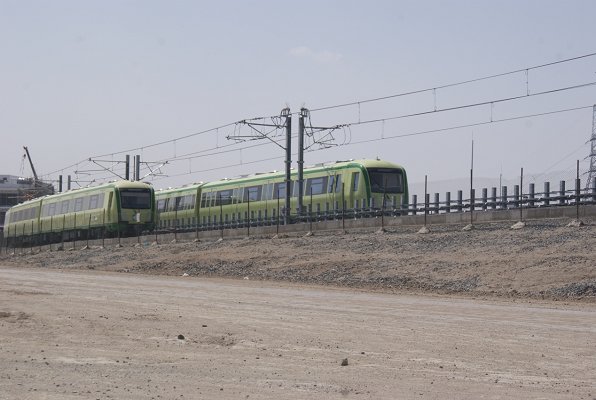
It was announced yesterday that Muslims wishing to use Makkah's first metro when they converge on the holy city next month for their annual pilgrimage will have to pay SR250 for a ticket that will serve them for seven days.
Three different types of tickets will cover all holy sites in Mecca and will allow the pilgrims to take the train into the city to perform their rites before returning to their residence inside or outside the city, Ajel online newspaper said, quoting Habib Zain Alabidin, Undersecretary at the Saudi Ministry of Municipal affairs.
"The ticket's price is set at SR250 (US$ 67) that will cover a full trip into and out of Makkah for seven days…another ticket is priced at SR100 (US$ 27) for four days," he said.
Officials said last week the train has a capacity to transport 170,000 passengers in its first stage and two million when the third and final phase is completed.
Saudi Arabia has allocated nearly SR6.7 billion (US$ 1.8 billion) for the metro, which begins continuous service next month for the first time in Mecca's history. Officials expect the project to largely contribute to easing road congestions caused by the accumulation of thousands of cars near Makkah.
Habib Zain Alabidin says the railway would operate throughout the year.
The project is part of a costly programme by Saudi Arabia to tackle massive traffic congestions in and around the city and facilitate access to all sacred sites in Mecca.
The train project, initiated three years ago, followed a series of incidents that have killed thousands of pilgrims in stampedes, building collapses and other accidents during the few days of the Haj season.
More than two million Muslims from Saudi Arabia, the Gulf Co-operation Council countries and other nations descend on Mecca every year to perform the pilgrimage.
China Railway Construction Corp, part of a Saudi-French-Chinese consortium which won the contract, is carrying out the project, involving nearly 5,000 workers. The train is the Gulf’s second metro system after the Dubai Metro.